Ask any exporter in Odisha what keeps their freight quote higher than expected & youll usually hear the same few answers port congestion,vessel availability,documentation delays.What rarely comes up,but probably should,is where the port actually sits on the map.
That might sound too simple to matter.It isnt.
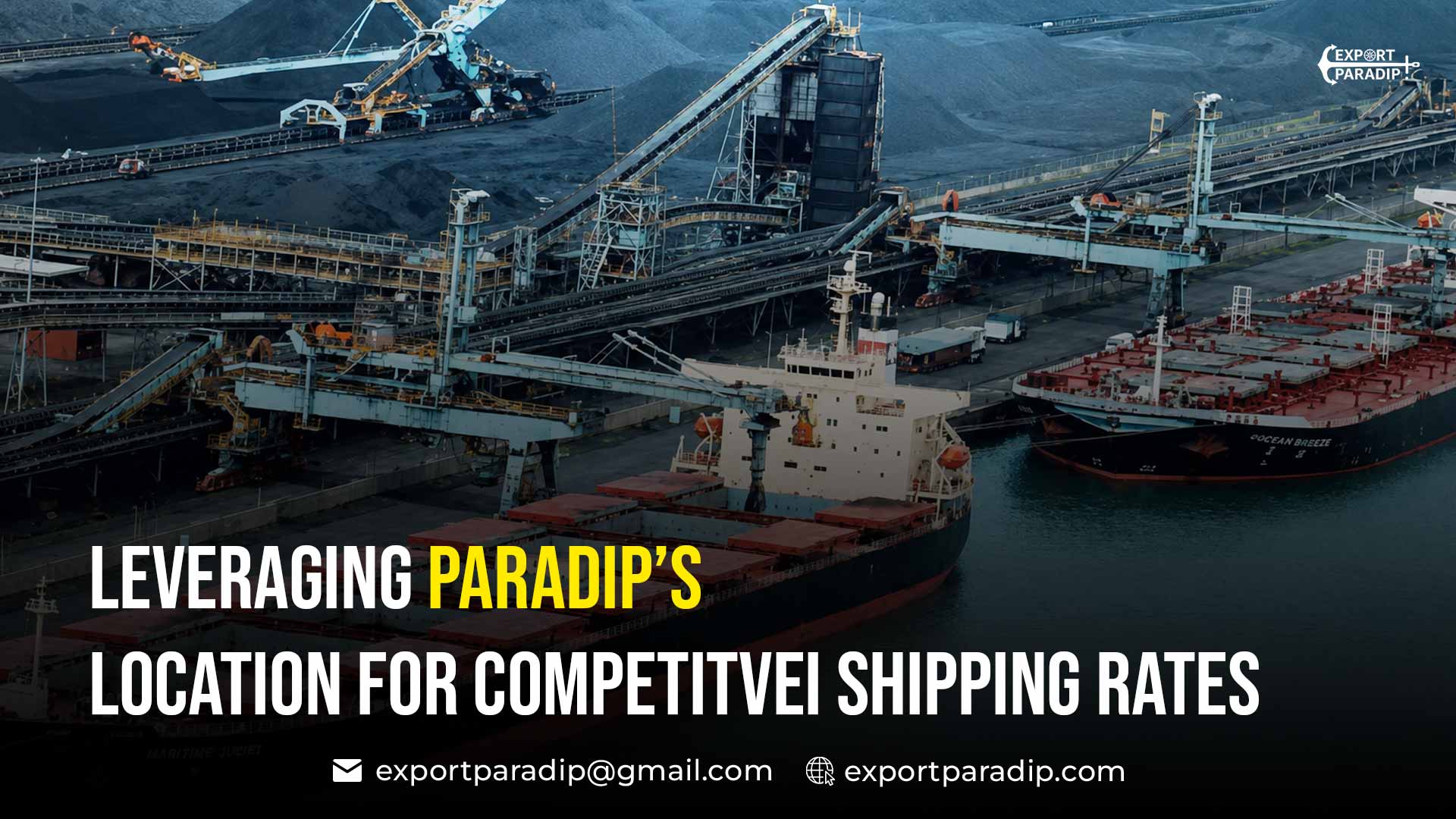
The port you ship from shapes your freight cost before a single negotiation happens.It decides how far the vessel has to travel,whether the ship can be large enough to bring that cost down & how many times your cargo gets transferred between vessels before it reaches the buyer.Paradip Port happens to sit in a position where all three of those things work in the exporters favour & most people exporting through it havent fully thought through what thats worth.
Why Location Drives Freight Costs
Heres the basic logic.Carriers dont set freight rates randomly.Theyre pricing in distance,how full they can get a ship on that route,how efficiently the port operates,and how often they can run the service profitably.Every extra nautical mile,every extra port call,every extra cargo transfer it all adds up somewhere,and the somewhere is usually your invoice.
Paradip sits right on the Bay of Bengal,which puts it naturally close to the lanes running toward East & Southeast Asia.West coast ports Mumbai,Nhava Sheva have to sail south past Sri Lanka before they can even head in the right direction.Thats not a small detour.And for cargo heading to Thailand,Malaysia,Singapore or South Korea,that difference in starting position shows up in the freight cost,even when nobody explicitly says so.
Vessel Visibility Gives Exporters a Planning Advantage
Real-Time Vessel Tracking & Shipment Planning Tools Efficient shipment planning requires visibility into vessel schedules & port activity. Export Paradip offers exporters access to two powerful digital tools:
Vessel Map: Track real-time vessel movements at Paradip Port
👉 https://exportparadip.com/online-services/vessel-map
Vessel Line-Up Schedule: View upcoming vessel arrivals, berthing times & cargo categories
👉 https://exportparadip.com/online-services/vessel-line-up-schedule
These tools allow exporters to plan dispatch timelines accurately, avoid port congestion & coordinate smoothly with international buyers.
Three Ways Paradip Keeps Freight Competitive
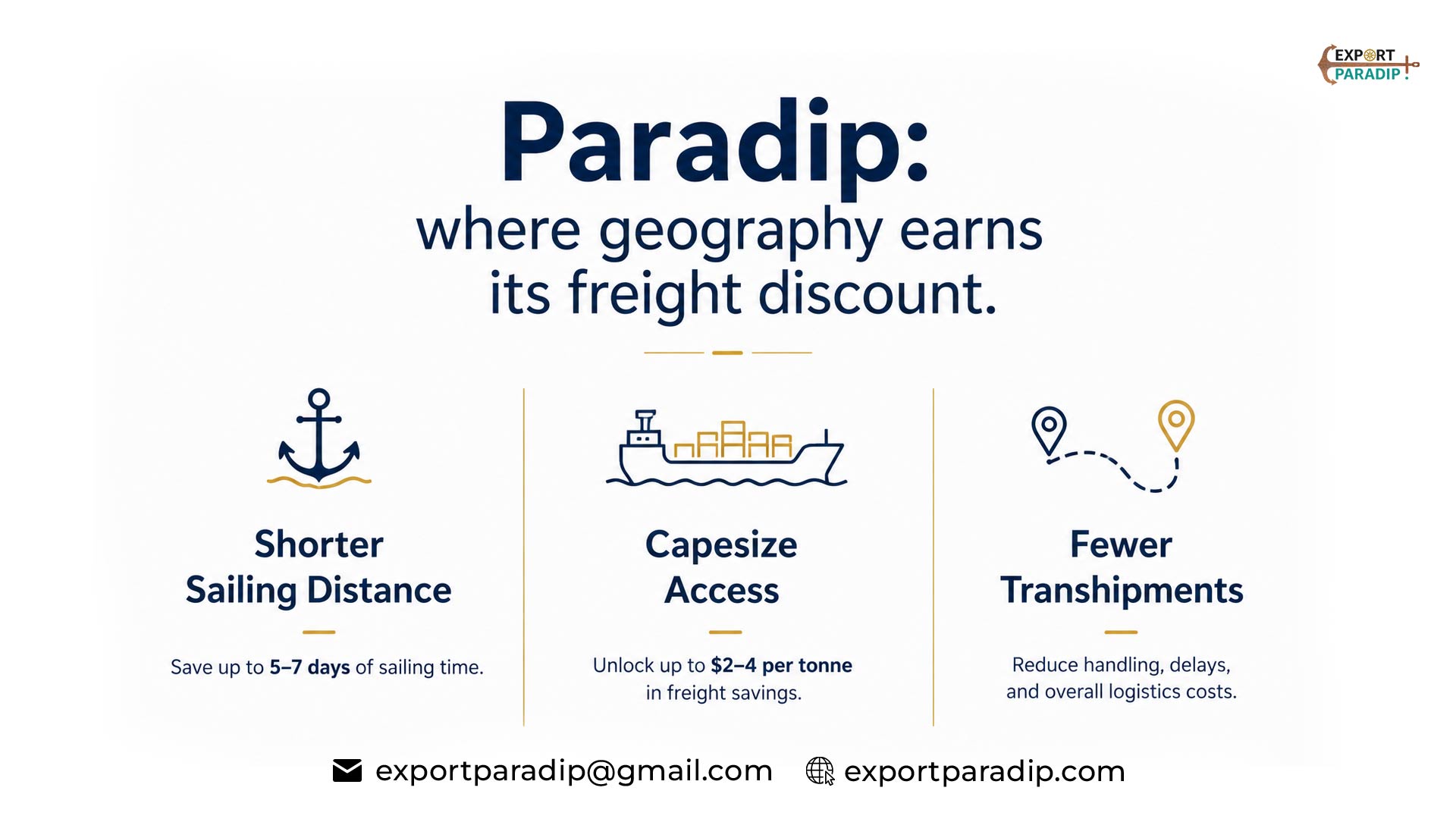
1.Youre closer to where the cargo is going This one is straightforward.Paradip is on the same side of India as its biggest export markets.A vessel leaving Paradip headed for Singapore or Colombo doesnt need to loop around the subcontinent first.That shorter sailing time isnt just convenient carriers factor it into what they charge,and the savings pass through to the freight rate.Not always obviously,but theyre there.
2.The port can take big ships & that changes the maths Paradips approach channel has been dredged to nearly 19 metres,which makes it one of the few Indian ports that can handle Capesize bulk carriers.These are large vessels.When a bigger ship is on the route,the freight cost per tonne of cargo goes down because youre spreading the operating cost across a much larger load.For bulk exporters moving iron ore,minerals or agricultural commodities,this isnt a small thing.Its the difference between a rate that works & one that squeezes the margin out of the deal.
3.Your cargo doesnt have to change ships mid-journey Transhipment where cargo gets offloaded at a hub port & transferred to a different vessel adds cost every time it happens.Handling fees,waiting time,another set of port charges.Paradips direct links into East Asian trade lanes mean a lot of shipments can skip that intermediate stop.The cargo goes on one ship,stays on it,and arrives.That simplicity has a price tag,and its a lower one.
So What Does an Exporter Actually Do With This?
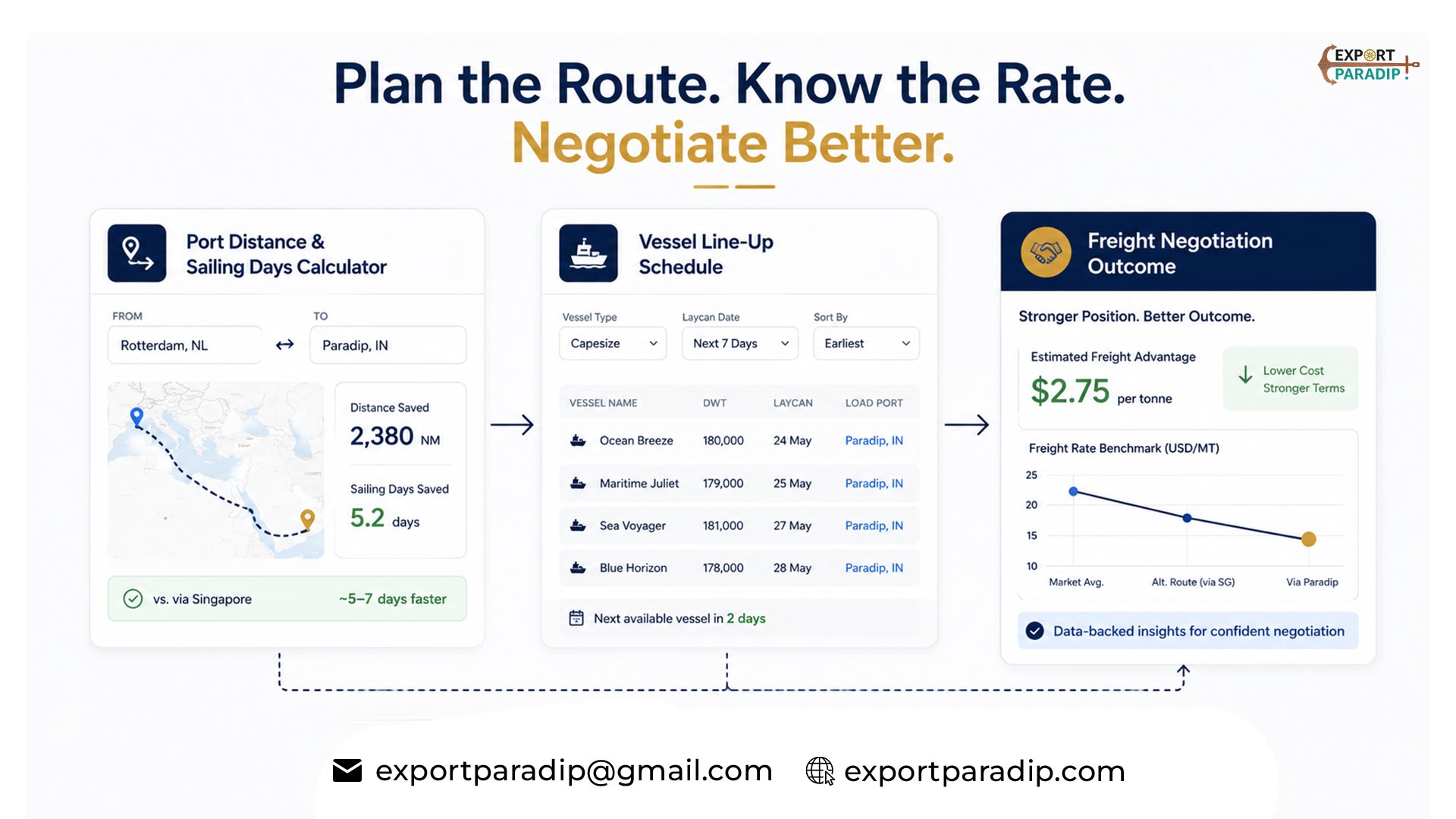
Knowing the port has a geographic advantage is useful.Turning it into a lower freight rate requires a bit more than just knowing. You need to know which vessels are actually calling at Paradip & when.You need to know how many sailing days it takes to reach your buyers port so youre not guessing on transit time.And ideally,you want to be able to compare what a direct shipment looks like versus one that goes through a transhipment hub because that comparison is exactly the conversation to have with a freight forwarder when youre pushing back on a quote.
Export Paradips Port Distance & Sailing Days Calculator does the distance & transit math for you.The Vessel Line-Up Schedule tells you which ships are coming & when.Use both together before you sit down with a carrier & youre negotiating with facts,not assumptions.Thats usually where the better rates actually start. The geographic advantage was always there.Most exporters just havent had a reason to look at it this carefully before.Now they do.
FAQ's
How does Paradip Port's location help reduce shipping costs?
Its position on the Bay of Bengal means shorter sailing distances to East and Southeast Asian markets compared to west coast ports that have to sail around Sri Lanka's southern tip first. Shorter routes translate to lower transit time and freight charges.
Can Paradip Port handle large bulk carriers like Capesize vessels?
Yes. Paradip has one of India's deepest approach channels at nearly 19 metres, allowing Capesize vessels to berth directly. Larger ships carry more cargo per voyage, which lowers the per-tonne freight cost for bulk exporters.
What is transhipment and why does avoiding it save money?
Transhipment is when cargo is offloaded at an intermediate port and transferred to a different vessel before reaching the final destination. Each transfer adds handling costs and waiting time. Paradip's direct sea lanes to major East Asian ports reduce the need for this extra step.
Which destination markets benefit most from shipping through Paradip?
Exporters moving cargo to Thailand, Malaysia, Singapore, Indonesia, Japan, and South Korea see the strongest advantage. These markets sit naturally along the Bay of Bengal trade corridor that Paradip opens onto.
How can Export Paradip help me calculate actual freight savings?
The Port Distance & Sailing Days Calculator on Export Paradip shows exact sailing distances and transit times to destination ports. Pair that with the Vessel Line-Up Schedule to plan around actual ship calls, and you have the data to negotiate freight rates from a posi