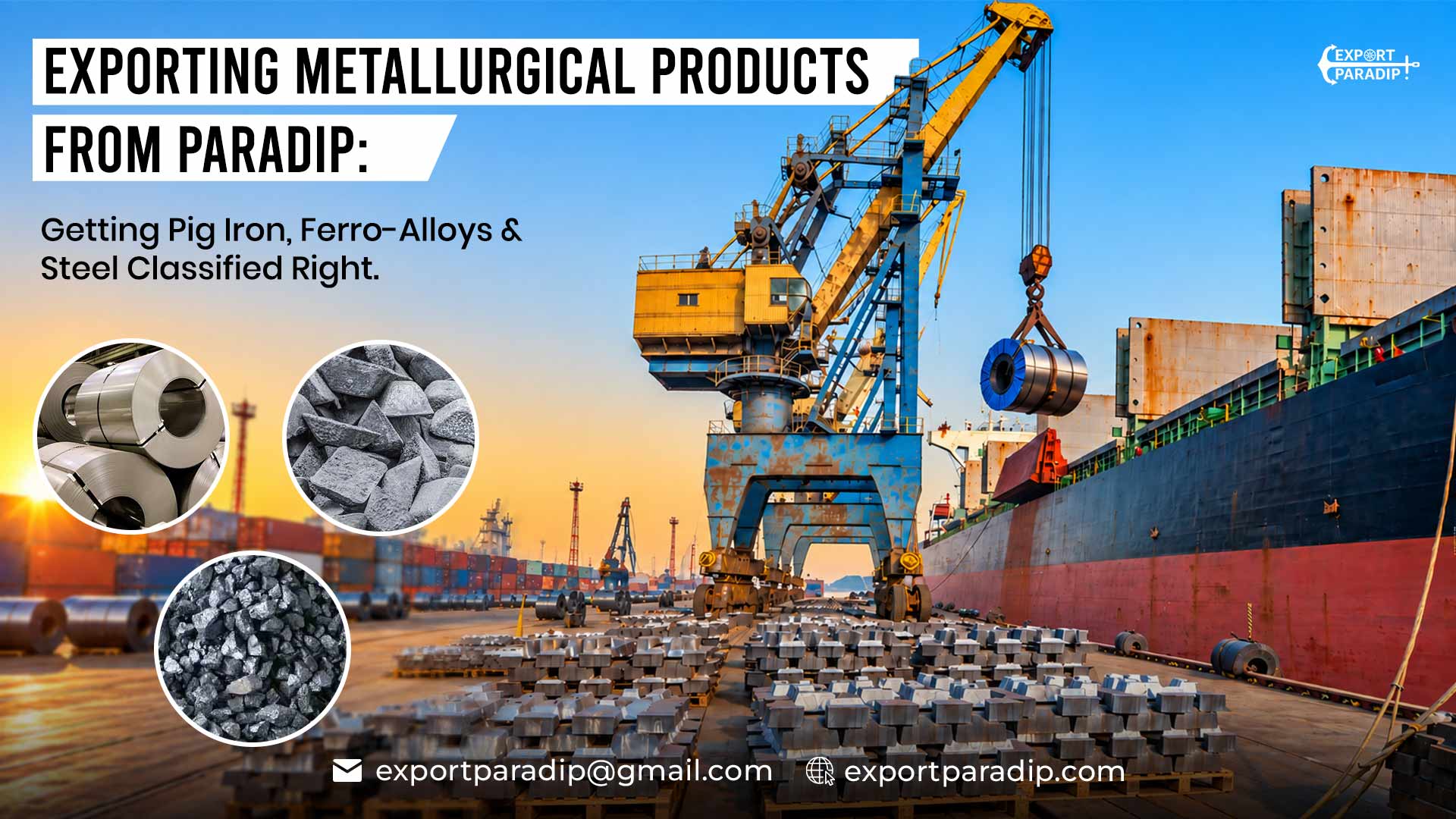
 Metallurgical exports span a wider range than most exporters assume pig iron, ferro-alloys, semi-finished steel, TMT bars & finished steel articles all move through Paradip Port under one broad category, but each carries its own classification logic, quality expectation & documentation need. For exporters shipping metallurgical products through Paradip, understanding where your product actually sits in this range matters more than it might seem.
🏷️ HS Chapter 72 vs. 73: The First Split That Matters
Metallurgical exports generally fall across two HS chapters, and confusing them is one of the more common classification errors:
-
HS Chapter 72 covers iron & steel in its primary & semi-finished forms pig iron & spiegeleisen (Heading 7201), ferro-alloys (Heading 7202), and semi-finished products like billets, ingots & TMT bars
-
HS Chapter 73 covers finished articles of iron or steel largely under Heading 7326, this includes fabricated steel goods, grinding balls & other finished components
The distinction isn't cosmetic. A product that's been rolled, forged or further processed into a finished article carries a different code and different duty & documentation expectations than the same material in raw or semi-finished form.
⚙️ Pig Iron & Spiegeleisen: Where Metallurgical Exports Start
Pig iron, classified under Heading 7201, is the primary form most steel production begins from cast into pigs, blocks or similar shapes before further processing. Spiegeleisen, a manganese-rich pig iron variant, falls under the same heading but serves a more specialised metallurgical role. For exporters, the key compliance detail here is chemical composition: pig iron's classification depends on meeting specific composition thresholds. Cargo that doesn't comply with the chemical composition standards defining pig iron, spiegeleisen or ferro-alloys can actually be reclassified under a different heading entirely which affects duty & documentation requirements downstream.
🧪 Ferro-Alloys: A Classification Built on Composition Thresholds
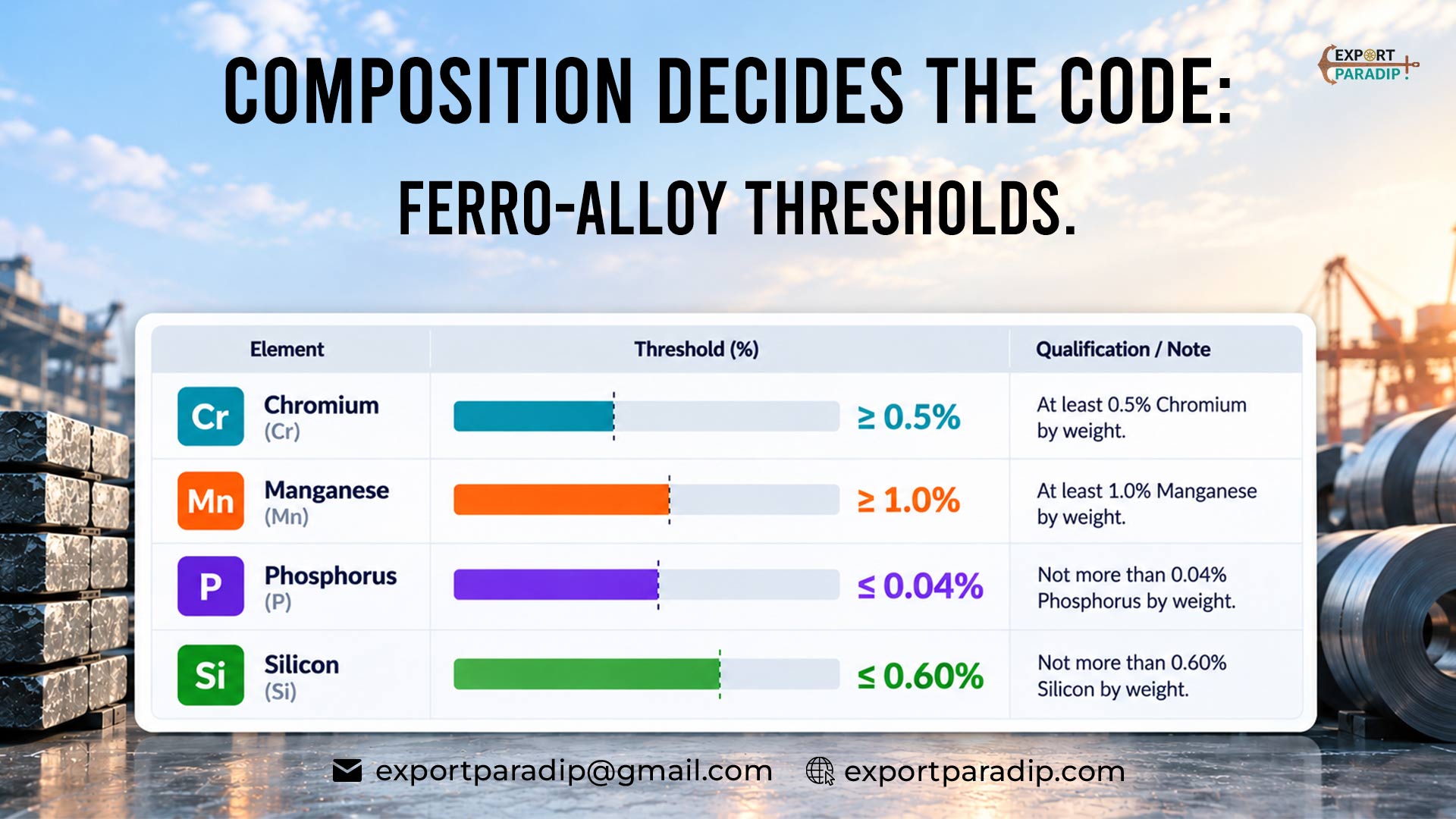
Ferro-alloys are one of the more precisely defined categories in metallurgical trade. Under Heading 7202, classification depends on the product containing 4% or more iron by weight, combined with specific thresholds of other elements more than 10% chromium, more than 30% manganese, more than 3% phosphorus, or more than 8% silicon, among other criteria.
This matters practically: if your ferro-alloy's composition doesn't meet these defined thresholds, it may not qualify for classification under this heading at all meaning your commercial lab analysis & composition certificate aren't just quality documentation, they're what determines your correct HS code in the first place.
🏗️ TMT Bars & Steel: Structural Products With Their Own Classification Logic
TMT (Thermo-Mechanically Treated) bars, widely used in structural reinforcement for civil engineering & residential construction, fall under steel classification within Chapter 72 specifically defined as ferrous materials containing 2% or less carbon by weight that remain usefully malleable, distinguishing them from cast iron or higher-carbon steel variants. With India's steel demand growing meaningfully in FY2026 & hot-rolled coil pricing holding in the ₹46,000–49,000/tonne range through Q1, TMT bars & structural steel remain a consistently active export category but one where correct classification still directly affects competitiveness on landed cost.
📋 Documentation That Matters for This Category
Beyond standard export paperwork, metallurgical shipments typically benefit from: ✔ Mill Test Certificate (MTC) confirming chemical composition & mechanical properties, often required by buyers before acceptance
✔ Certificate of Origin
✔ BIS compliance documentation, where applicable certain iron & steel articles are subject to mandatory Indian quality standards under import/export policy
✔ Correct HS classification confirmed against composition, not just general product category
💡 Export Paradip's Advantage: For ferro-alloys & pig iron specifically, keep your composition certificate on hand before you file since classification itself often hinges on the exact percentages, not just the product name on your invoice.
✅ Before Your Next Metallurgical Shipment
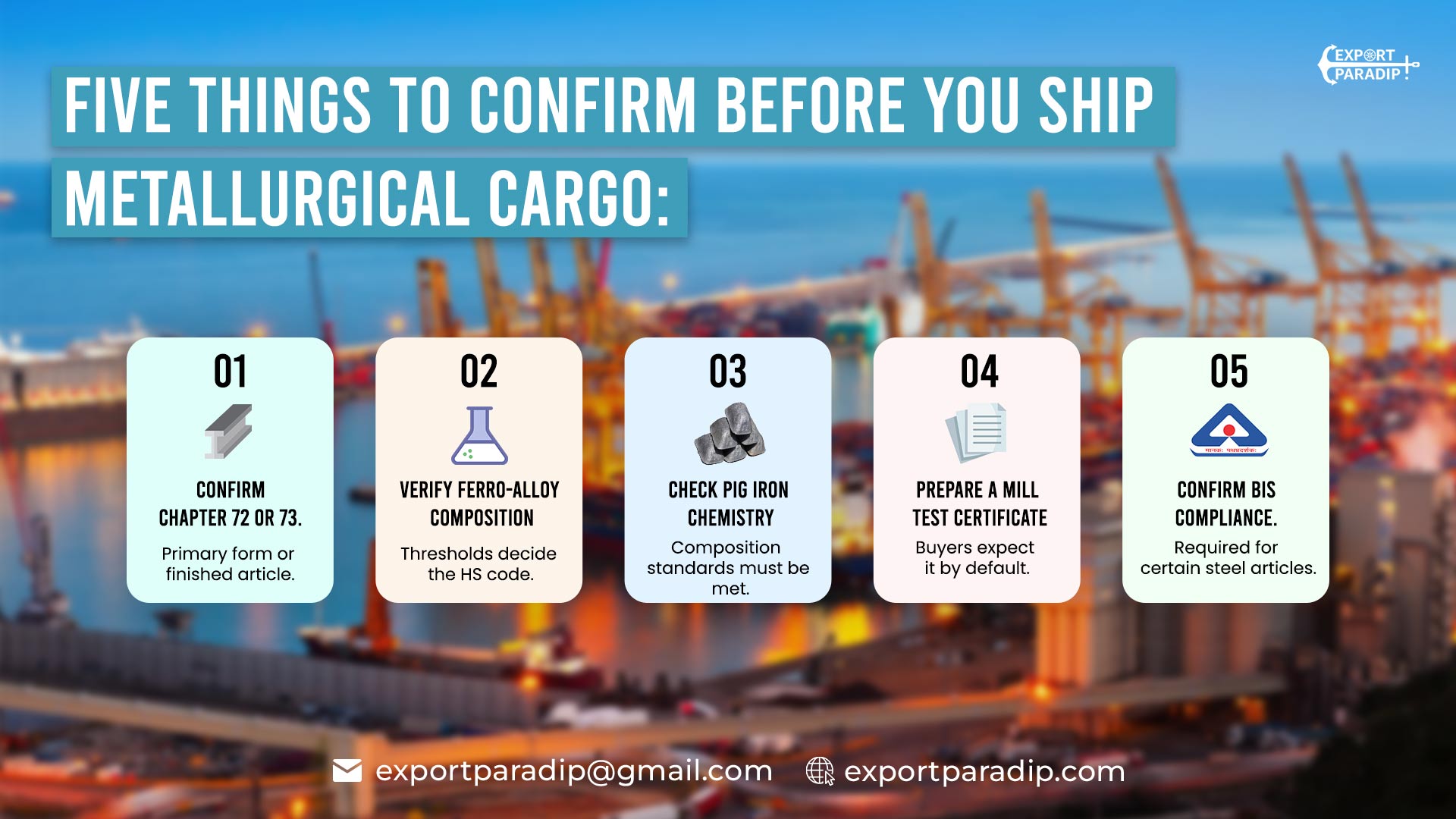
✔ Confirm Chapter 72 vs. 73 primary/semi-finished form or finished article
✔ Verify composition thresholds for ferro-alloys before assuming classification
✔ Check pig iron's chemical composition against defined standards
✔ Prepare a Mill Test Certificate for buyer acceptance
✔ Confirm BIS compliance where your product falls under mandatory quality standards
Export Paradip helps exporters shipping metallurgical products through Paradip Port confirm classification & keep documentation aligned with buyer & customs expectations. Get in touch to talk through your shipment, or verify your product's code with our HS Code Finder before you file.
FAQ's
What's the difference between HS Chapter 72 and Chapter 73 for steel exports?
Chapter 72 covers iron & steel in primary and semi-finished forms pig iron, ferro-alloys, billets and TMT bars. Chapter 73 covers finished articles of iron or steel that have undergone further fabrication.
How is a ferro-alloy classified under HS Heading 7202?
Classification depends on the product containing 4% or more iron by weight, along with specific thresholds of other elements like chromium, manganese, phosphorus or silicon. Products not meeting these thresholds may not qualify under this heading.
Do pig iron shipments need composition certification?
Yes pig iron's classification under Heading 7201 depends on meeting defined chemical composition standards. Cargo that doesn't comply can be reclassified under a different heading, affecting duty and documentation.
What documentation do buyers typically expect for metallurgical shipments?
A Mill Test Certificate confirming chemical composition and mechanical properties is commonly expected, alongside a Certificate of Origin and, where applicable, BIS compliance documentation.
Can Export Paradip help classify metallurgical products correctly?
Export Paradip helps exporters confirm HS classification through our HS Code Finder and shipment support. For composition-based classification questions specific to your product, we'd recommend pairing our guidance with a metallurgical lab analysis. Contact our team to get started.