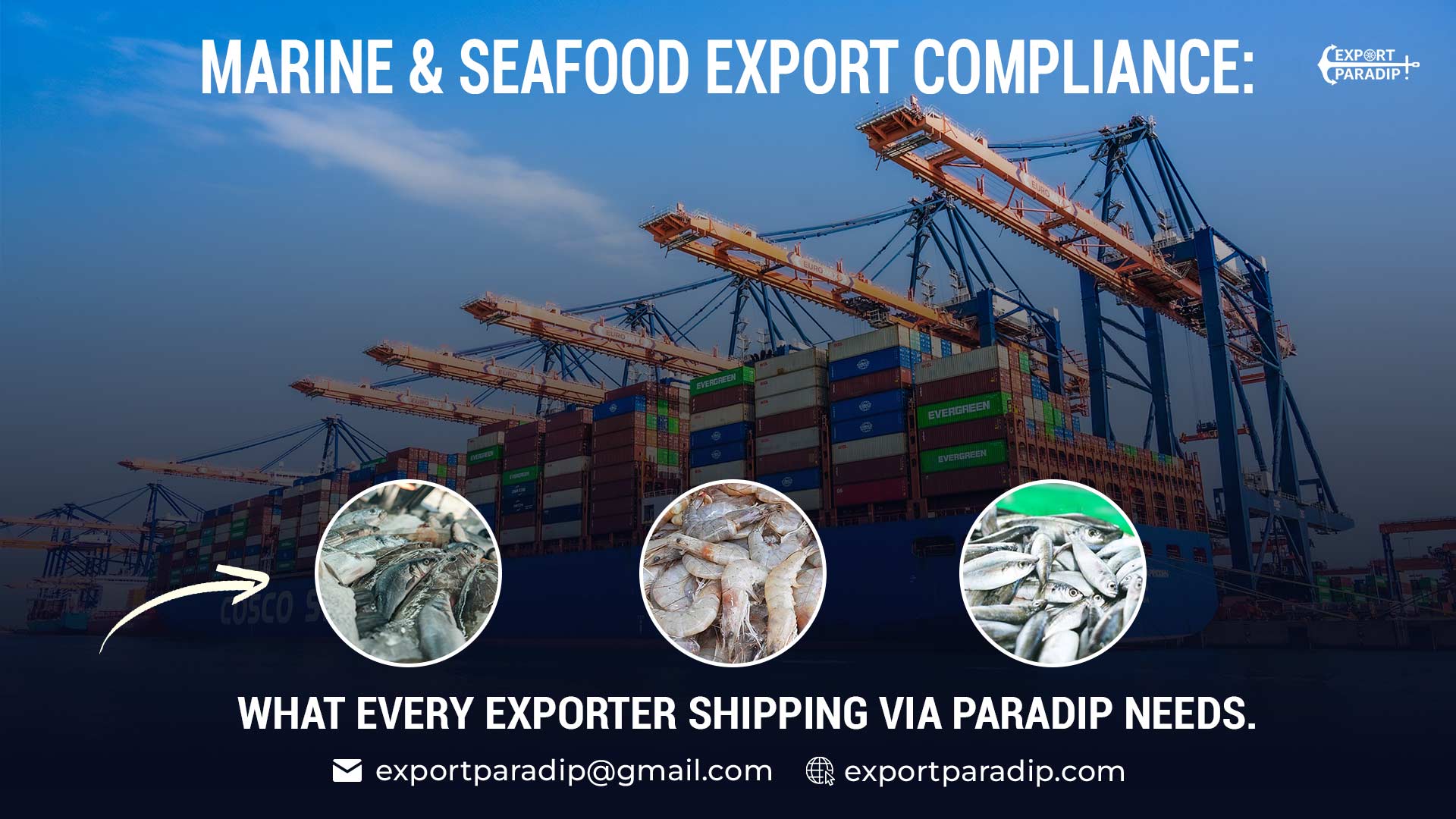
Introduction: A Product That's Judged Twice
Seafood is inspected once by India before it leaves, and again by the buyer's country before it's allowed in. Frozen shrimp alone accounts for roughly 85% of India's marine export value, making India the world's largest shrimp exporter but that scale comes with a compliance chain longer than almost any other export category shipped through Paradip Port. Missing one link in that chain doesn't just delay a shipment; it can mean the entire consignment is turned away at the destination port.
MPEDA: Where Every Seafood Exporter Starts
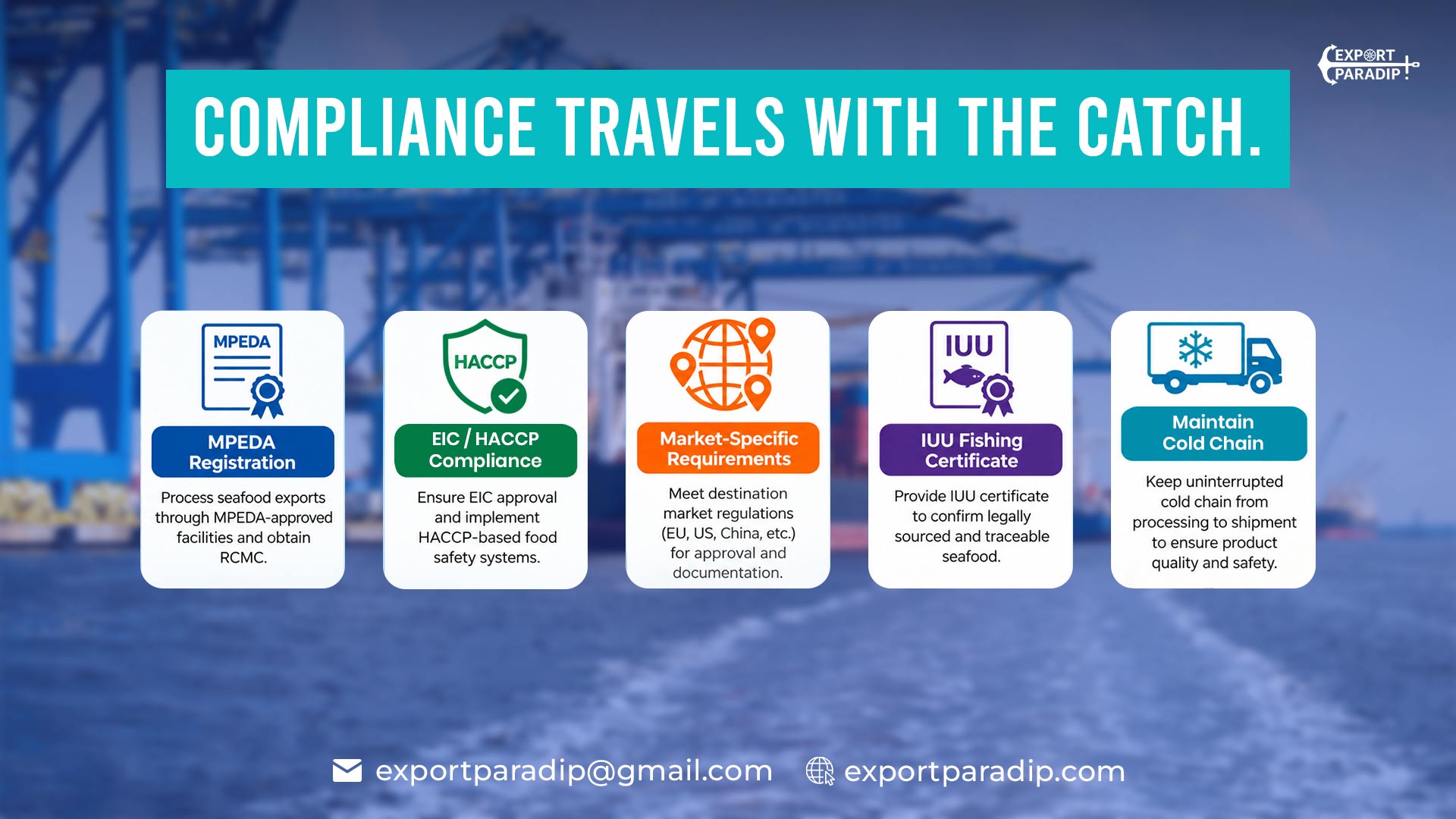
The Marine Products Export Development Authority (MPEDA) issues the Registration-Cum-Membership Certificate (RCMC), the mandatory starting point for exporting marine products from India (source: MPEDA official site Without an active RCMC, no seafood shipment can legally leave Indian shores, regardless of how it's otherwise documented.
EIC & HACCP: The Two Certifications Every Market Expects
Beyond MPEDA registration, two further approvals form the backbone of seafood export compliance: Export Inspection Council (EIC) approval, under India's Ministry of Commerce & Industry, confirms your processing plant meets quality & health standards recognised internationally. HACCP (Hazard Analysis & Critical Control Point) certification is mandatory for every seafood processing plant exporting from India, regardless of destination market it's the foundational food-safety standard underlying nearly every other certificate you'll need. If you're sourcing from a third-party processor rather than your own facility, verifying their EIC approval & HACCP status before committing to an order isn't optional diligence it's the difference between a shipment that clears and one that doesn't.
Market-by-Market: Why "Compliant" Isn't One Standard
This is where seafood exports genuinely diverge from most other export categories compliance requirements shift meaningfully by destination: EU-bound shipments require your processing plant to be on the EU-approved establishment list, a separate approval process from standard EIC certification that can take several months.
US-bound shipments require the processing facility to be registered under the US FDA's Food Safety Modernization Act (FSMA), with HACCP compliance specifically under 21 CFR Part 123.
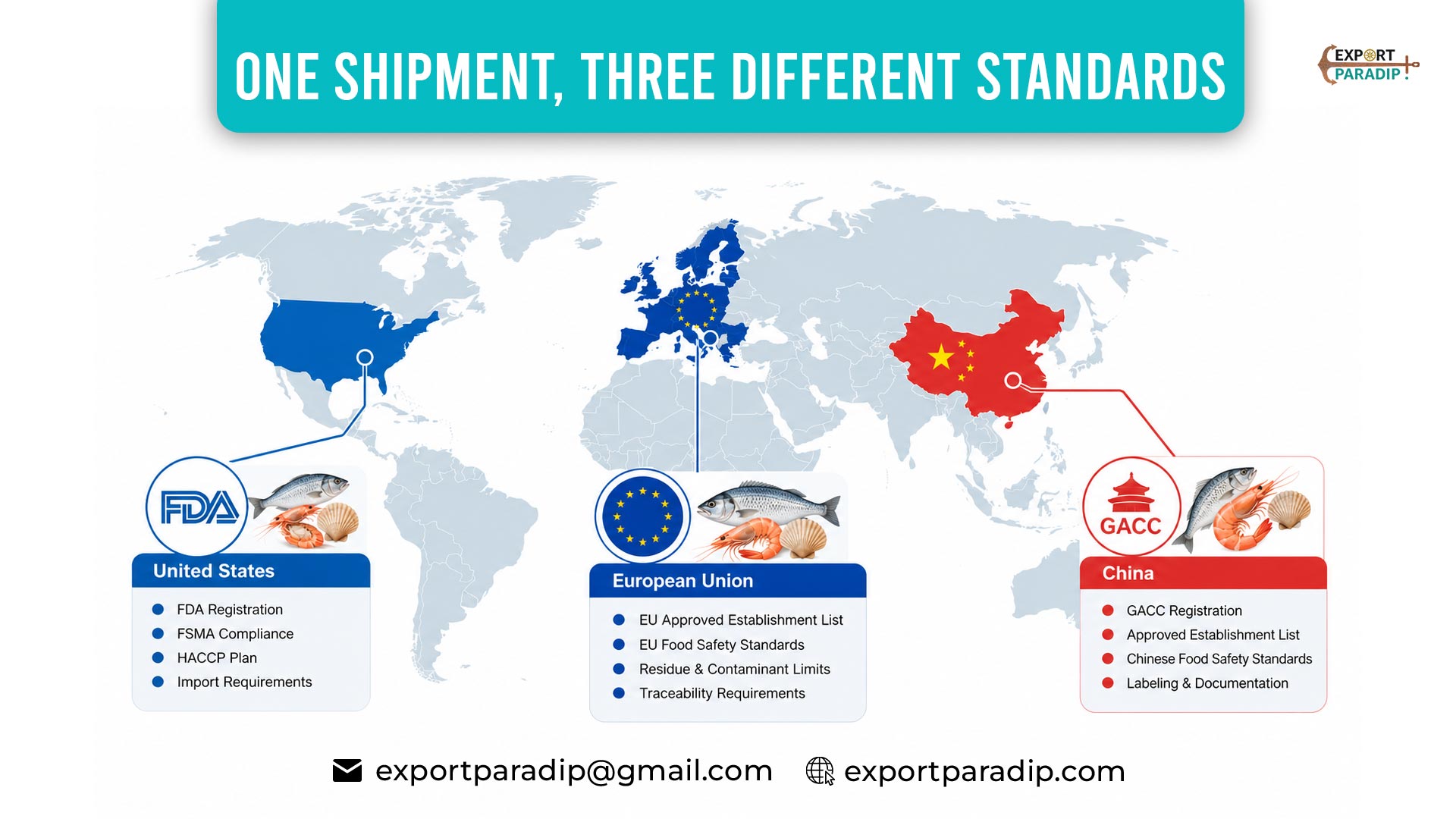
China-bound shipments (a rapidly growing market for Indian seafood) require registration with China's General Administration of Customs (GACC), Chinese-language labeling, and a certificate of origin. Assuming EIC approval alone satisfies every market is one of the more expensive mistakes new seafood exporters make each destination layers its own registration on top.
IUU Catch Certificates: Proving Legal Origin
For wild-caught seafood heading to the EU specifically, a Catch Certificate is required under the EU's IUU (Illegal, Unreported & Unregulated fishing) Regulation. This document traces your product back to a legally licensed fishing vessel without it, EU customs authorities can reject the shipment outright, regardless of how sound every other certificate is.
Farmed shrimp & aquaculture products generally sit outside IUU catch certificate requirements, but it's worth confirming this against your specific product & buyer's expectations rather than assuming.
Cold Chain: The Compliance Requirement That Never Stops
Every certificate in this chain assumes one underlying condition holds throughout transit: an unbroken cold chain. A single temperature excursion during transport can compromise both product safety and your HACCP documentation's validity which is why cold chain integrity through loading, transit & discharge at Paradip matters just as much as the paperwork itself.
Before Your Next Marine Shipment
✔ Confirm active MPEDA RCMC registration
✔ Verify your processing facility's EIC approval & HACCP certification
✔ Check destination-specific requirements EU list, US FDA/FSMA, or China GACC
✔ Secure an IUU Catch Certificate for EU-bound wild-caught seafood
✔ Maintain unbroken cold chain documentation throughout transit
Export Paradip helps exporters shipping marine & seafood products through Paradip Port keep certification & cold chain documentation aligned with buyer expectations. Explore our Export Documentation Checklist to see what your paperwork needs to include, or get in touch if you're preparing your first shipment to a new market.
FAQ's
Is MPEDA registration mandatory for all seafood exporters from India?
Yes the RCMC issued by MPEDA is the mandatory starting point for exporting any marine product from India, regardless of destination market.
Does EIC approval alone let me export to any country?
No. EIC approval is the baseline, but the EU, US and China each layer their own additional requirements EU-approved establishment listing, US FDA/FSMA registration, and China's GACC registration respectively.
What is an IUU Catch Certificate and when do I need one?
It's a document required for wild-caught seafood exports to the EU, proving the product traces back to a legally licensed fishing vessel. Farmed/aquaculture products generally don't require it, but this should be confirmed per shipment.
Is HACCP certification required for every seafood processing plant?
Yes HACCP certification is mandatory for all seafood processing plants exporting from India, regardless of which country the shipment is headed to.
Can Export Paradip help with seafood export documentation?
Export Paradip supports exporters shipping through Paradip Port with documentation guidance and shipment planning. For MPEDA, EIC or destination-specific certification, we'd recommend working directly with MPEDA or a certified export consultant. Contact our team to get started.