 Booking the wrong container size costs money in both directions. Underestimate your shipment's volume, and your cargo can get rolled left behind at the port because it physically doesn't fit what you booked. Overestimate, and you're paying to ship empty air. For exporters shipping through Paradip Port, getting this number right before booking is one of the simplest ways to protect your margin.
Export Paradip's CBM & Container Calculator does the math for you here's how to use it well, and what the numbers actually mean.
Booking the wrong container size costs money in both directions. Underestimate your shipment's volume, and your cargo can get rolled left behind at the port because it physically doesn't fit what you booked. Overestimate, and you're paying to ship empty air. For exporters shipping through Paradip Port, getting this number right before booking is one of the simplest ways to protect your margin.
Export Paradip's CBM & Container Calculator does the math for you here's how to use it well, and what the numbers actually mean.
📐 What CBM Actually Measures
CBM stands for Cubic Meter the standard unit freight forwarders & shipping lines use to measure shipment volume. The formula itself is simple: Length × Width × Height (in meters) = CBM per unit. Multiply that by your total quantity, and you have your shipment's total volume. The reason this matters more than it seems: ocean freight pricing is typically based on whichever is greater your cargo's actual weight, or its volumetric weight (a calculation derived from CBM). Light, bulky cargo often gets charged by volume rather than weight, which means an inaccurate CBM calculation can throw off your entire freight cost estimate before you've even booked.
📦 20ft vs. 40ft vs. 40ft High Cube: Choosing the Right Container
Once you know your total CBM, matching it to the right container size avoids both wasted space and overflow: 20ft Standard: ~33.2 CBM internal volume, though practical usable space runs closer to 25–28 CBM once you account for packing gaps & irregular shapes. Best suited for shipments in the 15–28 CBM range, or dense/heavy cargo that hits weight limits before volume limits.
40ft Standard: ~67.7 CBM internal volume, with roughly 55–60 CBM of practical loading space. Offers a meaningfully lower cost per CBM than two 20ft containers, making it the better choice once your shipment crosses into the 28–60 CBM range. 40ft High Cube (HC): ~76.3 CBM internal volume about 30cm taller internally than a standard 40ft. Well suited to light, bulky cargo like garments, furniture or packaged goods where you'll hit the volume limit long before the weight limit.
💡 Export Paradip's Advantage: As a rule of thumb, plan for 85–90% practical utilization rather than the full theoretical CBM figure loading access, dunnage & irregular cargo shapes mean you rarely fill a container to its exact theoretical maximum.
⚖️ Volume vs. Weight: Which One Actually Limits You
Every container has both a volume limit & a weight limit, and it's easy to assume volume is the binding constraint but for dense cargo, weight often hits first.
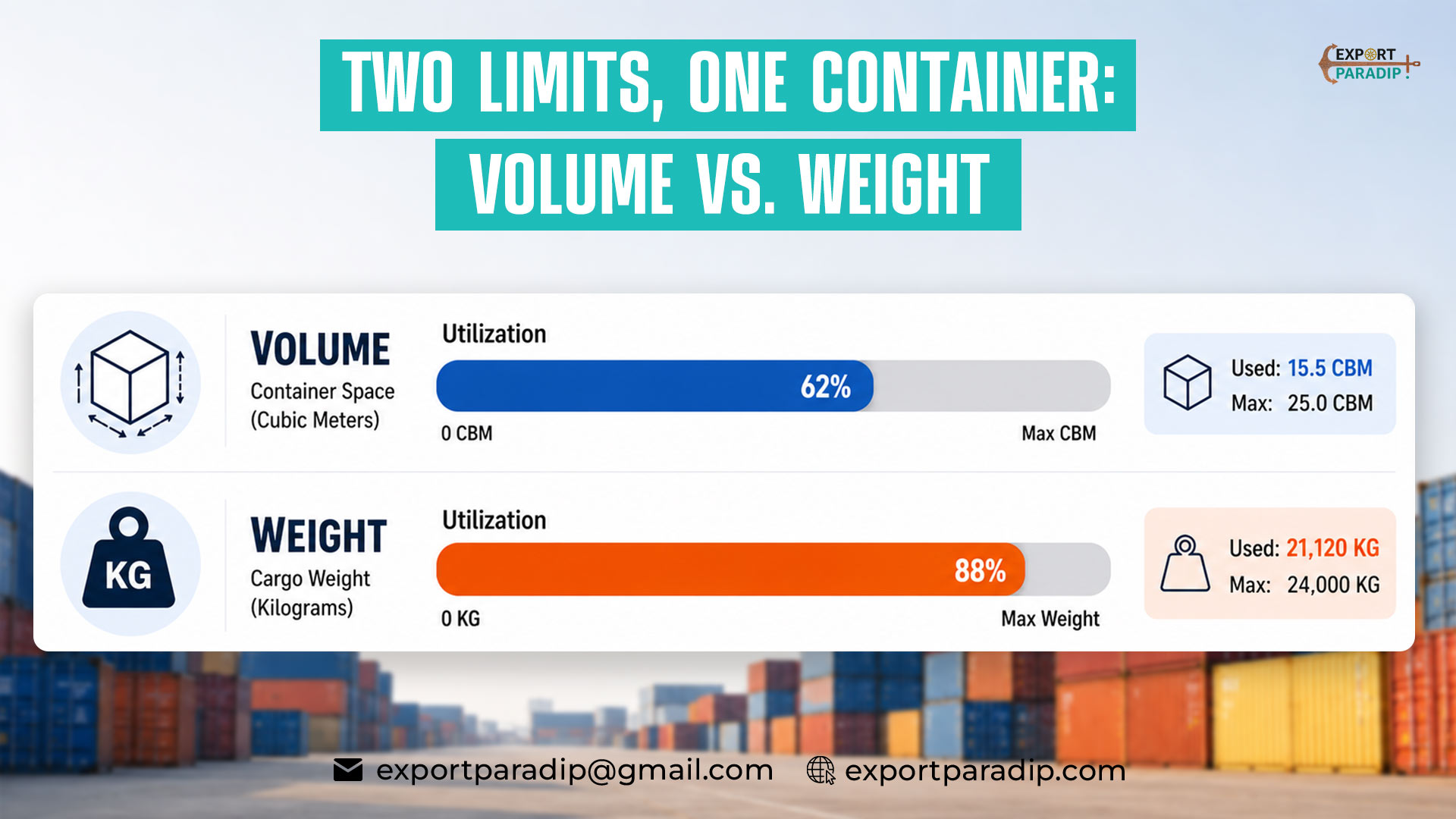
A 20ft container typically caps out around 21,700–28,000 kg, depending on the shipping line A 40ft standard container carries a similar weight cap despite offering roughly double the volume If your cargo fills only half the container by volume but already reaches the maximum weight limit, you're paying for unused space a sign you may be better off with a container built for lighter, bulkier freight instead. The calculator flags this by showing both your volume utilization and weight utilization side by side, so you can see which limit you'll hit first before you book.
🧮 How to Use the Calculator Correctly
Getting an accurate result depends on entering consistent, accurate inputs: Enter carton dimensions precisely length, width & height, in whichever unit you have (the calculator handles unit conversion, so use your supplier's actual figures rather than rounding).
Include total quantity, not just a single carton's dimensions the tool multiplies this out to your full shipment volume automatically. Add multiple product lines separately if you're shipping a mixed cargo load combining different-sized cartons into one estimate understates your real space requirement. Check both the volume and weight utilization bars before finalising your container choice don't rely on CBM alone.
✅ Before You Book Your Container
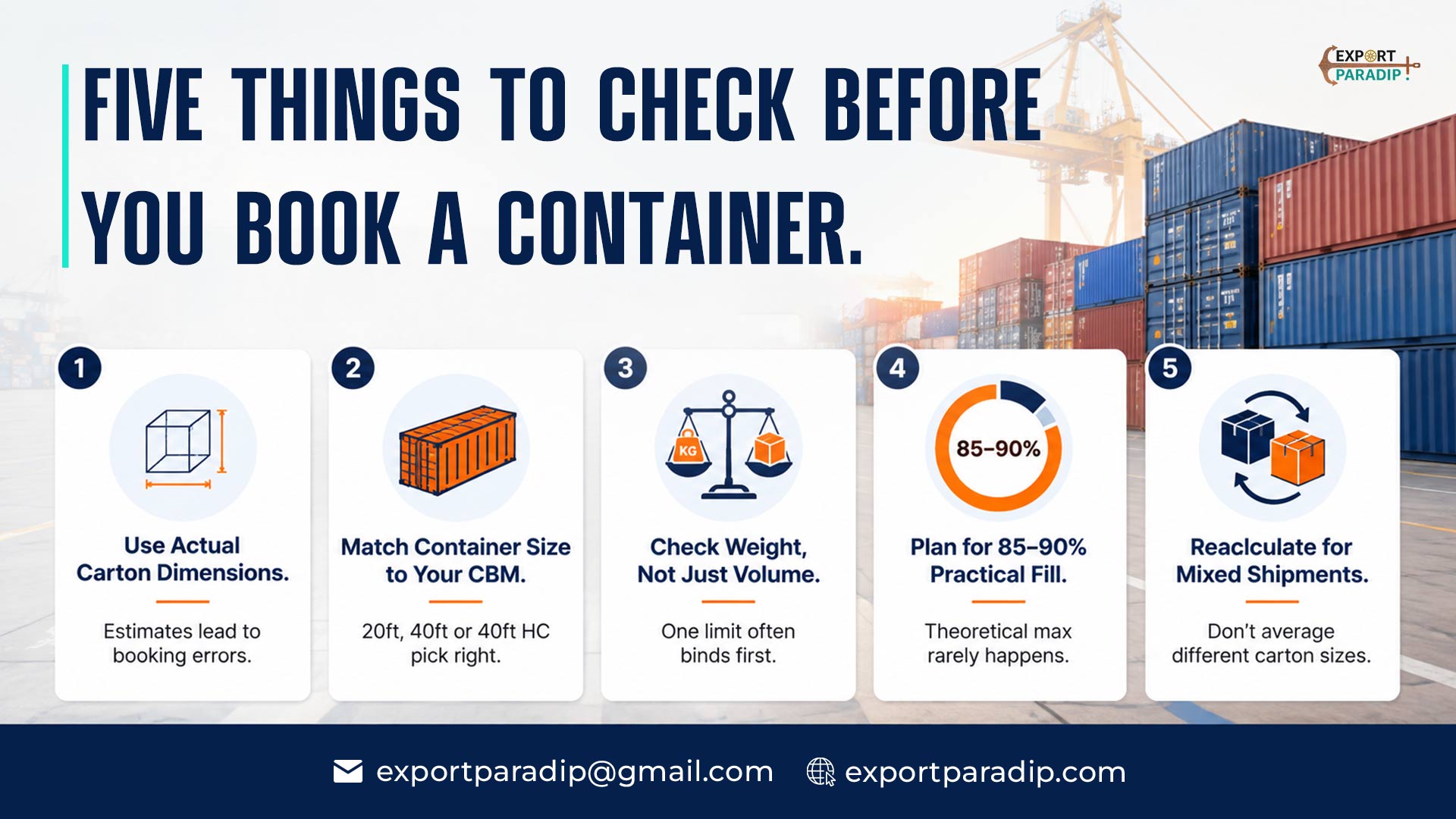
✔ Calculate CBM using actual carton dimensions, not estimates
✔ Check weight limits alongside volume one often binds before the other
✔ Plan for 85–90% practical fill, not the full theoretical capacity
✔ Choose 40ft HC for light, bulky cargo that hits volume limits early
✔ Recalculate for mixed shipments rather than averaging carton sizes
Export Paradip built the CBM & Container Calculator to help exporters shipping through Paradip Port book the right container size the first time. Calculate your shipment's CBM, or get in touch if you need help planning a mixed or high-volume shipment.
FAQ's
How do I calculate CBM for my shipment?
Multiply length × width × height in meters to get the CBM of one carton, then multiply by your total quantity. Export Paradip's CBM Calculator does this automatically once you enter your dimensions and quantity.
How much cargo actually fits in a 20ft container?
A 20ft container has about 33.2 CBM of internal volume, but practical usable space is typically 25–28 CBM once you account for packing gaps and irregular shapes.
Should I choose volume or weight when picking a container?
Both matter check whichever limit your cargo hits first. Dense, heavy cargo often reaches the weight cap before filling the available volume, while light, bulky cargo usually fills the volume first.
What's the difference between a 40ft standard and a 40ft High Cube container?
A 40ft High Cube has the same length and width as a standard 40ft but is about 30cm taller internally, adding roughly 8–9 CBM of extra usable space useful for light, bulky cargo.
Can Export Paradip help me plan a mixed-cargo shipment?
Yes while our CBM Calculator handles single and multi-product calculations, our team can help you plan container selection for more complex, mixed-cargo shipments. Contact us to get started.