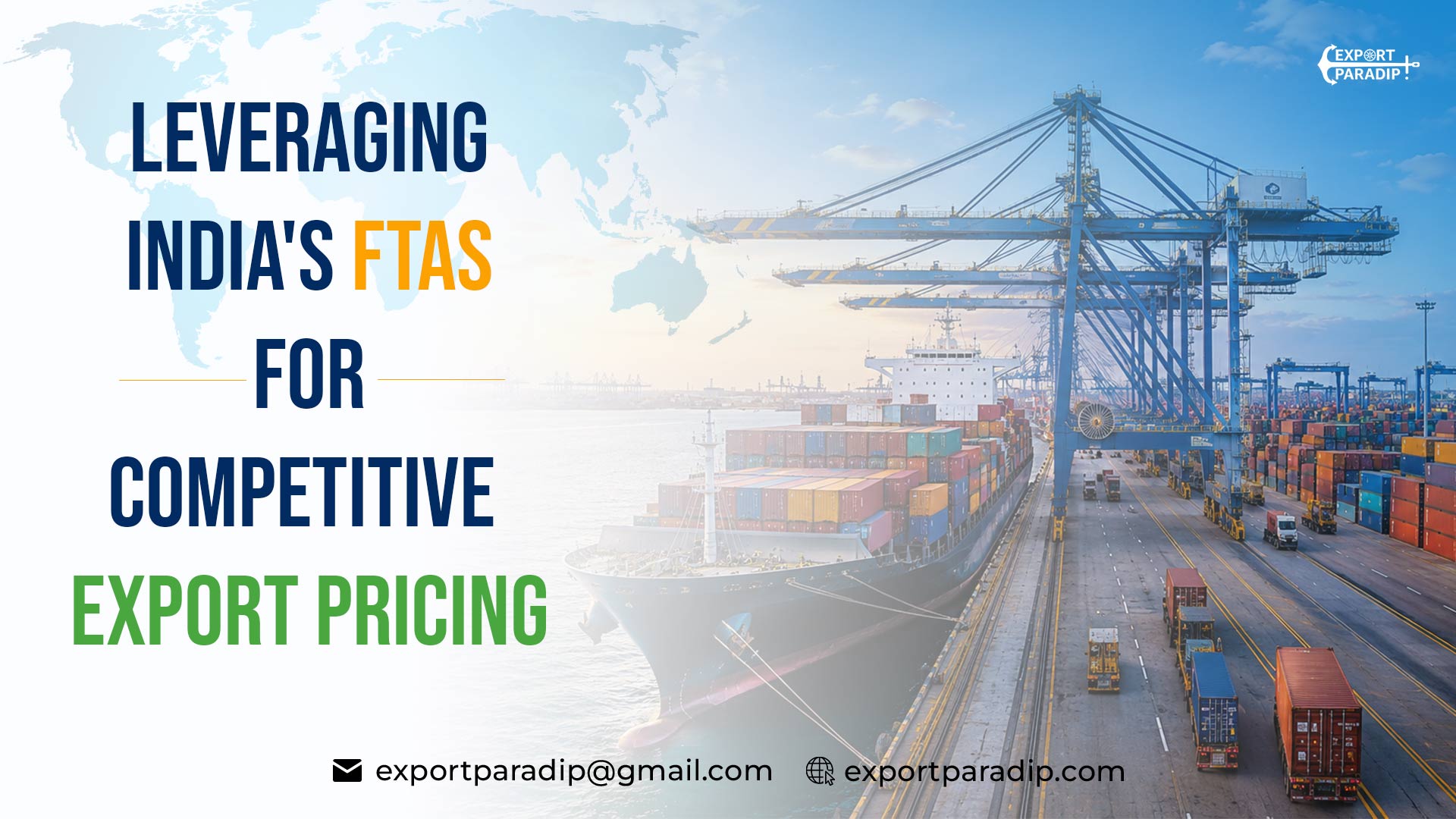
India has quietly built one of the most useful trade agreement networks in Asia & most exporters are barely tapping into it. Free Trade Agreements with ASEAN nations, Japan, South Korea, UAE, Mauritius, Sri Lanka & more recently Australia have created genuine pricing windows that Indian exporters can use right now.
For businesses shipping through Paradip Port, this matters quite a lot. Getting India FTA export pricing right is not just about knowing which agreement applies, it’s about building a proper system around it. Export Paradip works with exporters across multiple product categories to do exactly that.
What FTAs Actually Mean for Export Pricing
An FTA reduces or removes import duties between partner countries. For an Indian exporter, that translates into one thing your buyer in a partner country pays less at customs, which gives you room to either lower your price or keep the margin.
Consider a practical example. If a competitor from a non-FTA country faces a 10% import duty on minerals entering Japan, while Indian exporters face zero duty under the India-Japan CEPA, the Indian exporter has a structural pricing advantage before the deal even begins. That’s the real value of knowing your FTA landscape.
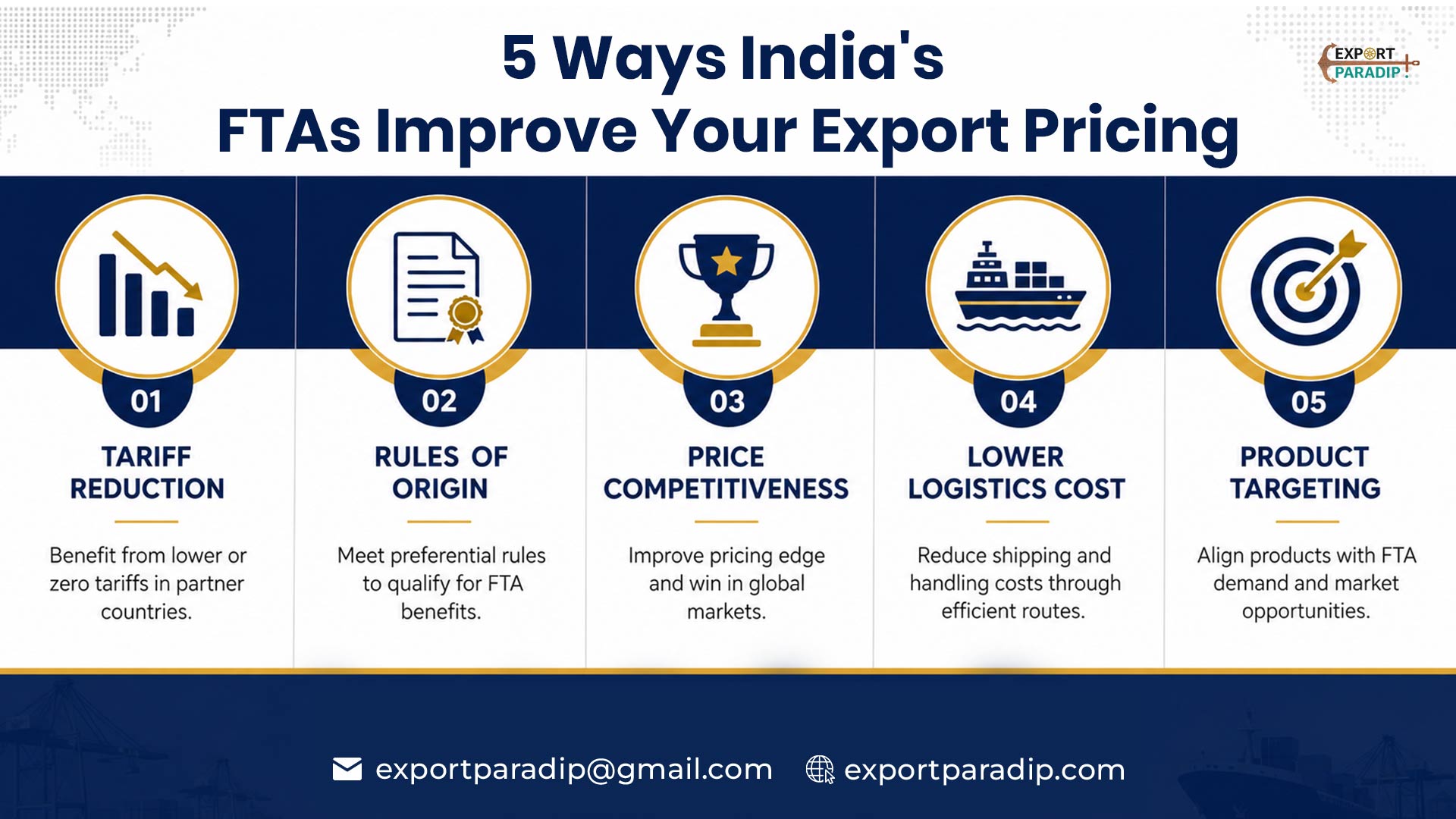
Five Ways FTAs Strengthen Your Export Pricing
1. Tariff Reduction on Core Export Products
Several categories that Export Paradip actively works with agricultural commodities, marine products, minerals & ores, processed chemicals, metallurgical goods and leather products attract meaningfully lower import duties in FTA partner markets. That reduction directly improves how competitive your price looks on a buyer’s purchase order.
2. Rules of Origin: The Document That Unlocks the Benefit
FTA duty benefits don’t apply automatically. Exporters have to prove their goods meet Rules of Origin criteria meaning the product is genuinely manufactured or processed in India to a sufficient degree. A Certificate of Origin is the primary document for this. Getting it wrong or skipping it, means your buyer pays full duty regardless of the FTA. Export Paradip’s Export Documentation Checklist helps ensure nothing slips through.
3. Better Margins or Better Quotes Your Choice
When your buyer’s customs cost drops, you have two options: pass that saving forward as a lower price to win more orders or keep your price steady and improve your margin. Neither is automatically right, it depends on your market strategy. But having that option at all is only possible when you’re actively using the right FTA. Exporters shipping to ASEAN, Gulf or East Asian markets through Paradip Port have real pricing leverage here.
4. Smoother Customs = Lower Landed Cost for Buyers
FTAs don’t just cut tariffs. They often simplify customs procedures too fewer inspections, faster clearances, reduced port storage fees. From a buyer’s perspective, that lowers the total landed cost of your product even further. Export Paradip’s Port Distance & Sailing Days calculator helps exporters identify the most efficient trade routes to FTA partner destinations, which directly feeds into cost planning conversations with overseas buyers.
5. Deliberate Product-Market Targeting
Some products simply perform better in specific FTA markets because of where duty concessions are deepest. Indian marine products, agricultural exports and leather goods hold strong positioning under several active FTA frameworks. Exporters who research this rather than just shipping wherever demand exists tend to build more durable international buyer relationships over time.
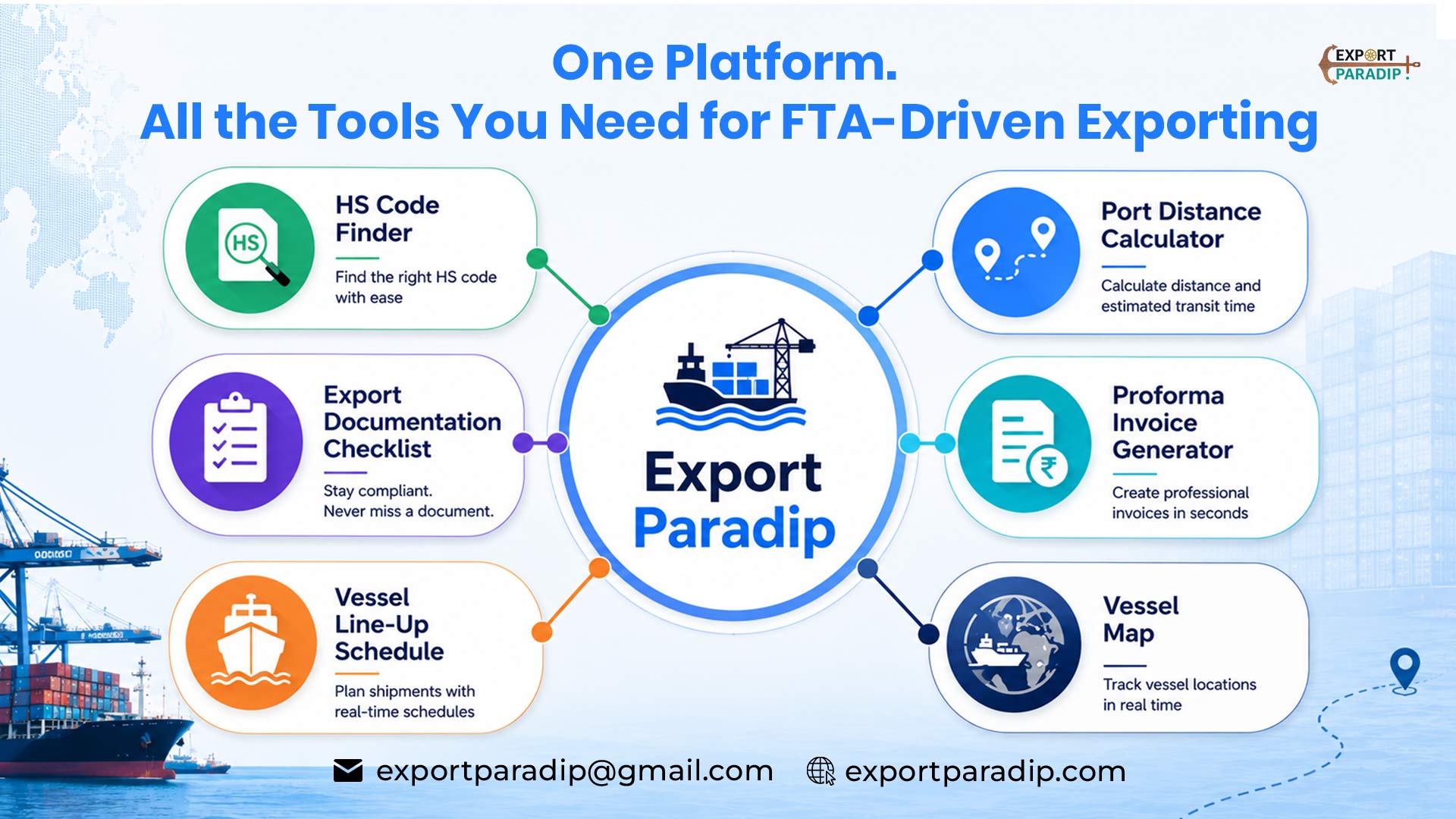
Export Paradip Tools That Support FTA-Aligned Exporting
Knowing FTA theory is one thing. Having the operational tools to act on it is another. Export Paradip provides a full digital toolkit for exactly this:
-
HS Code Finder: The starting point for any FTA claim. Correct HS classification determines whether your product qualifies for duty concession. Search across 12,000+ trade codes at exportparadip.com/online-services/hs-code-finder
-
Export Documentation Checklist: Ensures Certificate of Origin and all FTA-required paperwork is in order before shipment.
-
Port Distance & Sailing Days Calculator: Plan optimal routing to FTA partner country ports for cost-efficient delivery.
-
Proforma Invoice Generator: Create accurate export invoices aligned with FTA transaction value declarations.
-
Vessel Line-Up Schedule: Match your shipment timing with available vessels heading to FTA destination ports.
👉 https://exportparadip.com/online-services/vessel-line-up-schedule
Practical Tips for Exporters Using FTAs
-
Always verify FTA applicability using the correct HS Code before quoting a price to your buyer.
-
Keep clear manufacturing and sourcing records, they are the foundation of a valid Rules of Origin claim.
-
Tell your buyer about the FTA advantage upfront. It builds confidence and speeds up the deal.
-
Review FTA duty schedules periodically tariff rates under most agreements reduce in phases over time.
-
Use Export Paradip’s vessel scheduling tools to align shipment timing with trade routes that serve FTA markets efficiently.
How Export Paradip Connects Exporters to FTA Markets
Export Paradip operates as a complete export support ecosystem for businesses at or shipping through Paradip Port. The product range agricultural & agro-based products, marine products, minerals & ores, processed minerals & chemicals, metallurgical products and leather products sits squarely within the categories that gain most from India’s active FTA network.
Beyond product trading, Export Paradip provides real-time vessel tracking, export documentation support, logistics planning tools and market guidance. These aren’t separate services, work together to give exporters what they actually need: the ability to move goods on time, at the right price with the right paperwork.
FTA Benefits Only Work If You Use Them
India’s trade agreements represent real, tangible pricing power for exporters but only for those who understand them well enough to apply them correctly. India FTA export pricing is not a concept reserved for large corporations. Any exporter with the right product, proper documentation and a reliable shipping plan can compete on price in markets where duty concessions apply.
FAQ's
What is India FTA export pricing and why does it matter for exporters?
India FTA export pricing refers to the cost advantage to Indian exporters gain when goods enter FTA partner countries at reduced or zero import duty.
Which Indian export categories gain the most from FTA duty concessions?
Agricultural commodities, marine products, minerals, leather goods and metallurgical products hold strong FTA positioning.
What documents are required to claim FTA tariff benefits on a shipment?
A valid Certificate of Origin, commercial invoice, packing list and correct HS Code classification are the core documents required to claim FTA.
How does HS Code classification affect FTA duty eligibility?
The HS Code determines whether a product falls within the duty concession schedule of a specific FTA.
How does Export Paradip help exporters use India’s FTAs effectively?
Export Paradip provides an HS Code Finder, Export Documentation Checklist, Proforma Invoice Generator, Port Distance Calculator and Vessel Scheduling tools.