 You've handled the paperwork, chosen the right payment terms & tracked the vessel schedule. But none of that protects you if a container shifts in rough seas, a fire breaks out in the hold, or a shipment simply never arrives. That's where marine cargo insurance comes in & for many exporters, it's the one piece of the puzzle they only think about after something's already gone wrong.
For exporters shipping through Paradip Port, understanding your coverage options before you ship isn't optional risk management it's the difference between absorbing a total loss and getting made whole.
🛡️ Institute Cargo Clauses: A, B & C Explained
Nearly every marine cargo policy in India is built around the Institute Cargo Clauses (ICC) a set of internationally recognised coverage standards formulated by the Institute of London Underwriters. Since they're used globally, ICC-based policies also give Indian exporters credibility with overseas buyers & banks.
There are three tiers, and the difference between them is significant:
-
ICC (A) — All Risks: The broadest cover available. It insures against loss or damage from nearly any external cause theft, mishandling, water damage, natural disasters except for a short list of specific exclusions. Best suited for high-value cargo like electronics, machinery or branded goods.
-
ICC (B) — Named Perils: Covers a defined list of specific risks fire, collision, capsizing, general average but not general mishandling or partial damage from lower-severity events.
-
ICC (C) — Basic Cover: The narrowest tier. It typically responds only to major, catastrophic transport events like fire, collision or the vessel sinking. Minor damage from rough handling generally isn't covered.
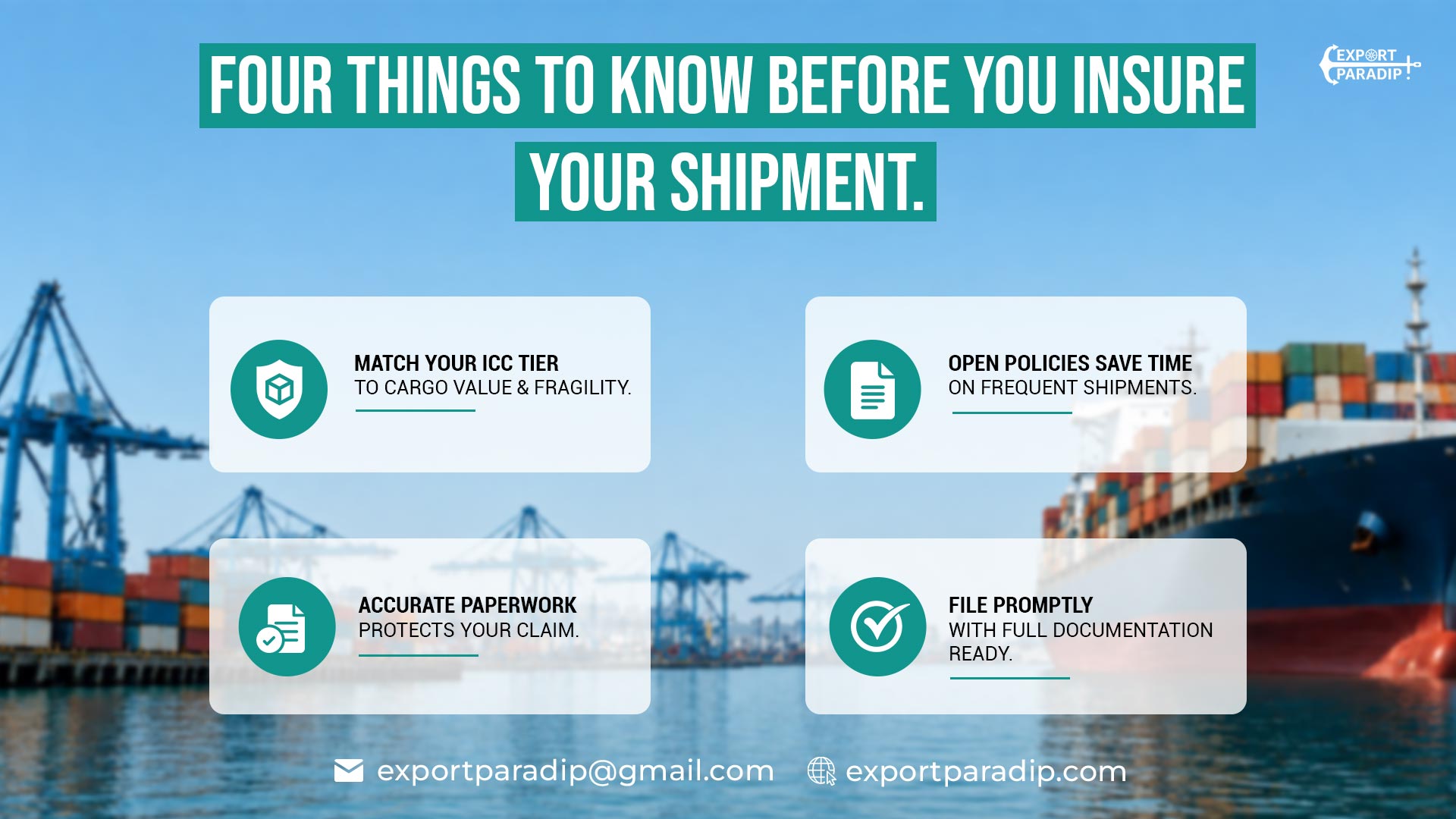
💡 Export Paradip's Advantage: As a rule of thumb, match your ICC tier to your cargo's value & fragility. Bulk raw materials moving in stable conditions can often be insured under B or C to control premium costs but high-value or damage-sensitive goods are rarely worth under-insuring.
📄 Choosing a Policy Structure: Single Shipment vs. Open Cover
Beyond the ICC tier, you'll also need to decide how your policy is structured:
Specific Voyage Policy: Covers one shipment, from origin to destination & ends once that cargo is delivered straightforward for occasional or one-off exporters.
Open (Floating) Policy: Covers all shipments made within a fixed period, typically a year, under a single umbrella policy. For exporters shipping regularly through Paradip, this dramatically cuts down on paperwork & means every shipment is automatically covered without arranging insurance shipment-by-shipment.
Valued vs. Unvalued Policy: A valued policy pre-agrees the cargo's declared value, so claims settle faster against that fixed number. An unvalued policy calculates compensation based on actual proven loss at claim time more flexible, but slower to settle. For exporters with frequent, predictable shipment volumes, an open policy paired with a valued cargo declaration is usually the combination that saves the most time when a claim does arise.
💰 What Drives Your Premium
Marine cargo premiums generally scale with the breadth of cover you choose broader "all risks" coverage under ICC A typically costs more than the narrower protection under ICC C, reflecting the wider range of scenarios the insurer is exposed to. Your premium will also reflect your cargo's declared value, the route & ports involved, and how the goods are packed. It's worth resisting the temptation to under-insure purely to save on premium. A denied or under-settled claim on a total loss almost always costs more than the premium difference would have.
📋 What Invalidates a Claim (And How to Avoid It)
Marine cargo claims get denied or disputed more often over paperwork & process gaps than genuine coverage disputes. The most common issues:
-
**Misvalued cargo — ** declaring a value that doesn't match the actual shipment
-
Poor packing — most policies exclude damage caused by inadequate packaging, regardless of ICC tier
-
Documentation errors — mismatched invoices, packing lists or bills of lading can stall or derail a claim
-
Late notification — most policies require prompt notice of loss or damage; delays can weaken your claim
Keeping your shipping documents consistent & accurate isn't just a customs requirement it's what makes an insurance claim resolve quickly if you ever need to file one.
✅ Filing a Claim: What to Have Ready
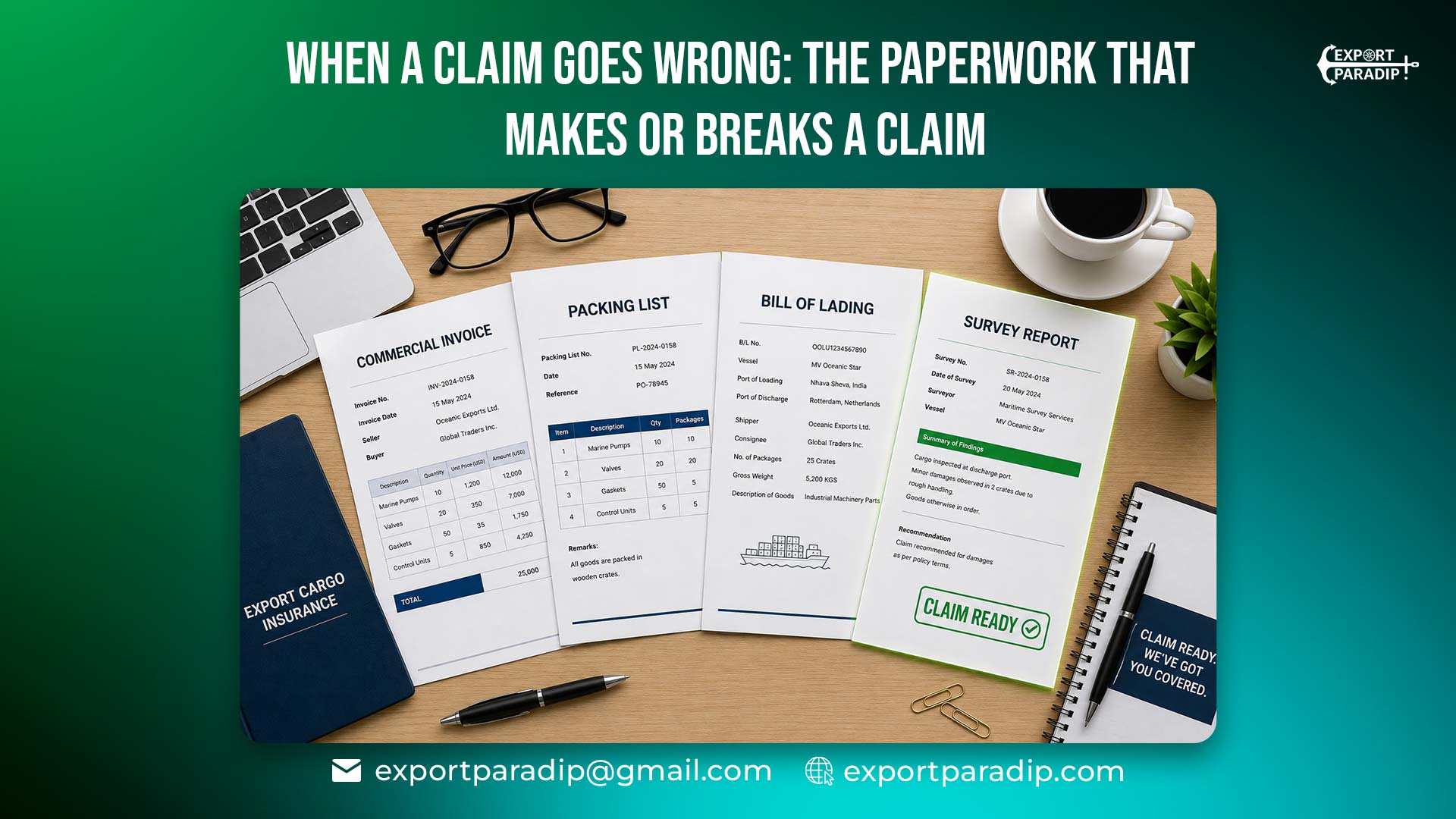
If damage or loss does occur, having the right documentation ready from day one speeds up settlement significantly:
✔ Original insurance policy or certificate
✔ Commercial invoice & packing list
✔ Bill of lading
✔ Survey report or damage certificate, arranged promptly after discovering the loss
✔ Notice of claim, filed within your policy's specified timeframe
Export Paradip helps exporters shipping through Paradip Port keep documentation consistent across shipments which matters just as much for insurance claims as it does for customs clearance. Get in touch to talk through your shipment, or revisit our export documentation checklist to make sure your paperwork holds up if you ever need to file.
FAQ's
What's the difference between ICC A, B and C cargo insurance?
ICC A offers the broadest "all risks" cover, ICC B covers a specific named list of perils like fire and collision, and ICC C offers the narrowest protection, generally responding only to major catastrophic events. The right tier depends on your cargo's value and fragility.
Do I need a new insurance policy for every shipment?
Not necessarily. If you ship regularly, an open (floating) policy covers all shipments within a fixed period — usually a year — under one policy, saving you from arranging cover shipment by shipment.
Why do marine cargo insurance claims get denied?
Claims are most often denied or delayed due to misvalued cargo, poor packing, documentation mismatches, or late notification of loss — not usually because the loss itself falls outside coverage.
Is marine cargo insurance mandatory for exporters in India?
It's not mandated by IRDAI, but most international buyers and banks expect it, and it's the only protection against total loss during transit. Going without it means self-insuring the full value of every shipment.
Can Export Paradip help me with cargo insurance?
Export Paradip supports exporters with documentation guidance so your shipping paperwork stays consistent — which matters directly for smooth insurance claims. For policy selection and premiums, we'd recommend working directly with an IRDAI-registered marine insurer. Contact our team to get your documentation export-ready.