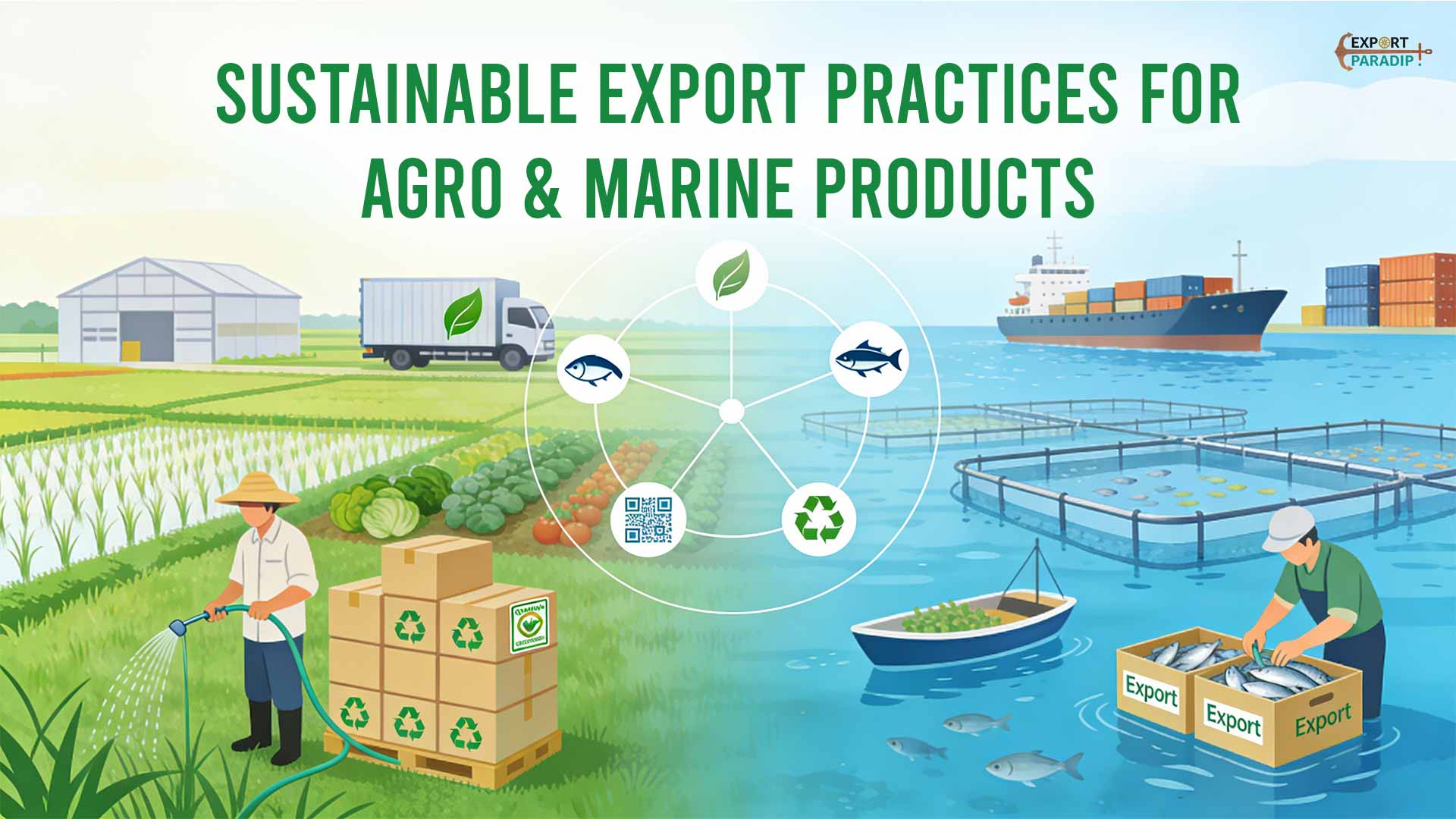
 The global export ecosystem is undergoing a major transformation & it is being driven not only by demand & pricing but by a renewed expectation of sustainability. In the past, commodities moved freely across borders with little thought toward ecological impact. But today’s importing nations, particularly the US, Japan, the UK, EU member states & developed Gulf markets, have transitioned toward strict sustainability-linked import frameworks. For Indian exporters dealing in agro & marine products, this shift presents both a challenge & a strategic opportunity. The world no longer just wants products, it wants products that are traceable, responsibly sourced, ethically harvested & processed with minimal environmental impact.
Agro & marine exports are among India’s strongest export pillars, accounting for billions in foreign exchange earnings every year. However, global buyers are increasingly evaluating exporters not only on price competitiveness but on traceability, soil & water responsibility, safe harvesting methods, packaging waste management & carbon footprint reduction. Sustainable export practices are therefore no longer optional, they are a competitive necessity, a profit driver & the foundation of long-term continuity in international trade.
The Global Push Toward Sustainability: Why It Matters More Than Ever
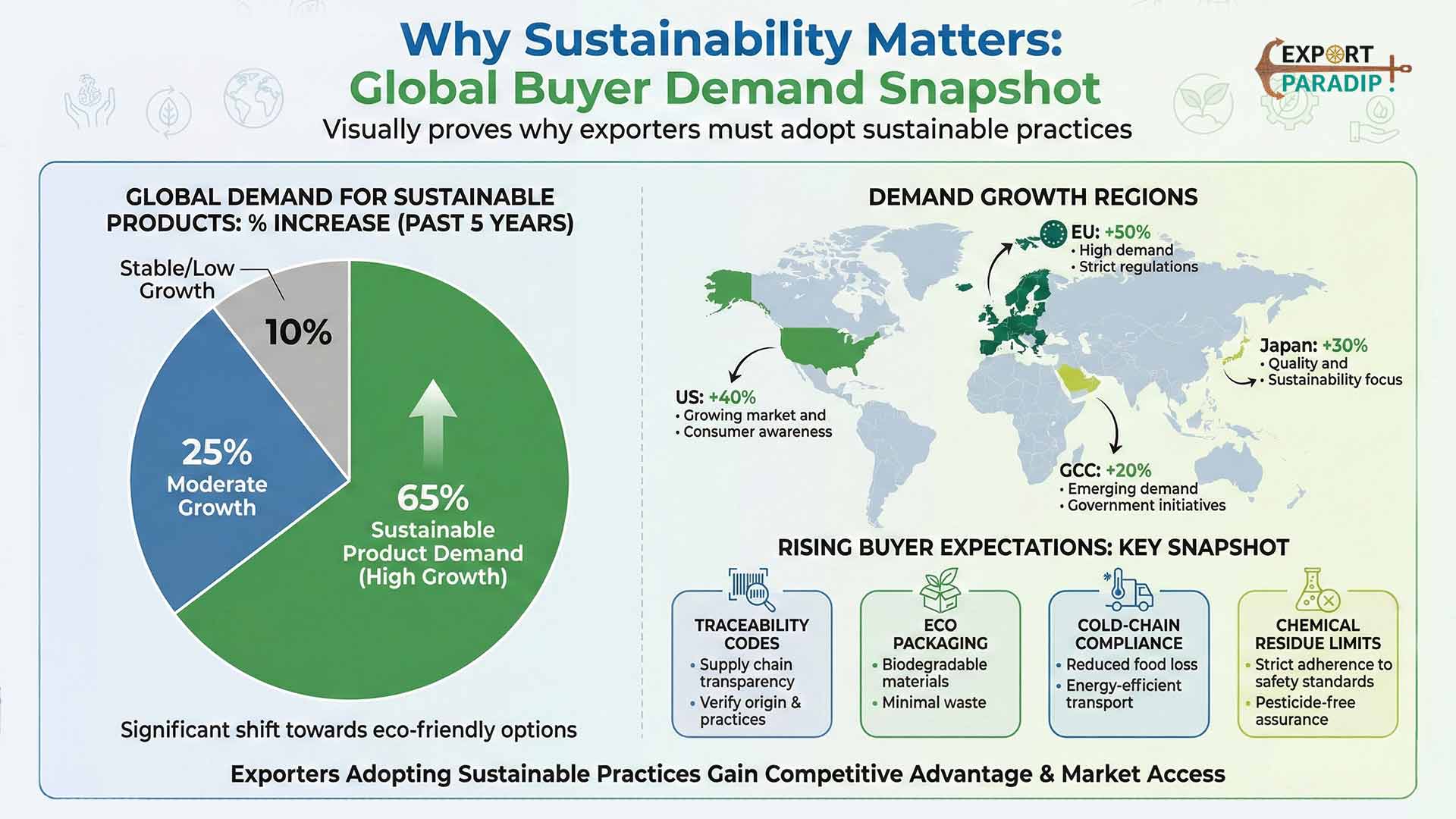
Sustainability has become a defining selection criterion in global trade. The shift has been fueled by a combination of environmental concerns, regulatory frameworks & consumer mindset evolution. Climate change, marine depletion, soil infertility & overuse of chemicals have placed tremendous pressure on governments & supply chains worldwide. As a result, importing nations now enforce stringent standards related to pesticide residue, fishing methods, cold-chain integrity, water usage & packaging recyclability.
Consumer behaviour has played a strong role in this transition as well. Modern buyers, whether retail or bulk, wholesale or supermarket, prefer labels that showcase responsible production. A sustainably grown mango, a residue-free basmati rice shipment, or responsibly harvested shrimp can attract far higher valuation than conventionally sourced alternatives. Sustainability has become a commercial opportunity rather than just a compliance box & exporters who adopt responsible practices early unlock markets that pay premiums for disciplined supply chains.
Sustainable Agro Export Practices That Boost Global Approval
For agro exporters, the first & most critical shift is reducing chemical dependency. Excessive pesticide use continues to be one of the biggest reasons for shipment rejections in Europe & North America. Sustainable farming begins with residue-free cultivation, bio-fertilizers & the adoption of natural pest management methods such as integrated pest management (IPM). When exporters work directly with farmers to train them in soil testing, chemical intervals & allowed-input lists of importing countries, compliance becomes smoother & rejection rates decline dramatically. Water responsibility is another pillar of sustainable agriculture. Drip irrigation, rainwater harvesting, mulching systems & moisture-control sensors help reduce water wastage while increasing yield. Water-efficient agriculture is especially critical for crops like grapes, rice, chilli & fresh vegetables, all major Indian export items. Exporters who support farmers in installing smart irrigation systems do not just cultivate sustainability, they build a pipeline of future-ready, globally accepted sourcing.
Equally important is soil health preservation. Healthy soil produces better colour, higher purity, richer aroma & longer shelf life, all of which improve export-grade quality. Practices like crop rotation, organic composting, reduced tillage, micronutrient rebalancing & mycorrhizal bio-cultures help restore soil naturally. When soil quality improves, the export chain benefits at every level: yields increase, quality stabilises & traceability documentation becomes easier to defend in front of international inspection bodies.
Post-harvest losses in India remain alarmingly high, often 30 to 40% in perishable categories. Sustainable practices therefore expand beyond cultivation & continue into cold-chain handling. Pre-cooling products immediately after harvest, using ventilated crates rather than sacks, monitoring temperature during transport & opting for reefer container shipping where necessary significantly reduces wastage. Cold-chain sustainability is not just about efficiency, it is one of the strongest ESG (Environmental, Social, Governance) identifiers in global food supply chains. Exporters who maintain uninterrupted cold-chain integrity have better product retention & more stable buyer relationships.
Responsible Marine Export Practices: Sustainability Below & Beyond the Waterline
Marine exports face stricter sustainability scrutiny than almost any other category, because the ocean’s biodiversity is dwindling. Importing countries increasingly demand proof of responsible fishing, traceable sourcing, species-wise quota adherence & eco-friendly catching methods. For exporters, sustainability in marine trade begins at the source, in the nets cast, the boats deployed & the waters harvested.
Sustainable marine export starts with ethical fishing practices. This includes respecting seasonal catch bans, avoiding destructive trawling, reducing bycatch through selective nets & maintaining legal harvest distances from breeding zones. Buyers increasingly request GPS-based location tracking & vessel documentation to verify ethical sourcing. Exporters who invest in responsible harvest traceability find fewer barriers in premium markets like Japan & the European Union.
Aquaculture sustainability is equally significant. Global buyers now expect proof of feed transparency, water-quality monitoring, antibiotic-free farming & humane stocking density. Shrimp, fish fillets, cuttlefish & other seafood exported from India attract better pricing when farms maintain high dissolved oxygen levels, use controlled feed cycles & adopt wastewater treatment systems. Certification bodies such as ASC, BAP & MSC have become indicators of trust & acquiring them leads directly to value-enhanced demand.
The marine sector additionally demands uninterrupted temperature management. A frozen shrimp, tuna loin or fish fillet loses quality drastically if temperature fluctuates between farm, processing plant & shipping dock. Ammonia-free refrigeration systems, solar-powered cold warehouses, blast freezing at -40°C & IoT-based temperature tracking are emerging as key sustainability tools. By building a cold-chain that runs without compromise, exporters not only reduce spoilage, they build credibility.
Sustainable Packaging & Carbon-Responsible Logistics
Packaging is the first thing international buyers see & it shapes their perception of sustainability. Traditional plastics, non-recyclable laminates & mixed-material sacks are gradually being replaced by eco-friendly alternatives like kraft paper, jute/hemp bags, PLA bioplastic trays, pulp-based cushioning, recyclable LDPE & water-based barrier coatings. For fruits, vegetables, dry commodities & frozen seafood, exporters adopting biodegradable packaging witness higher acceptance rates & premium positioning in retail markets that advertise sustainable food shelves.
Carbon responsibility extends beyond packaging into logistics. Consolidating shipments, reducing empty load runs, optimising palletisation & selecting shipping carriers that offer carbon-offset programs contribute significantly to lowering environmental impact. When logistics efficiency improves, exporters save fuel, cut down emissions & reduce cost burdens, a perfect balance of economic & ecological advantage.
The Rise of Traceability: The Future Language of Global Trade
As global borders tighten quality protocols, documentation is becoming as valuable as the product itself. Exporters that implement digital traceability systems are consistently preferred over those operating on fragmented manual records. Blockchain-based batch logs, QR-coded product origin labels, digital phytosanitary documentation, online FDA approvals, real-time shipment monitoring & automated compliance records make the supply chain safer & dispute-proof. Traceability is not merely a monitoring tool, it is a trust engine. When buyers can scan a QR code & know exactly where wheat was grown, how shrimp was harvested, which vessel transported it & what storage temperature maintained it, decision-making becomes faster. Exporters who invest in traceability today will own the most valuable brand assets tomorrow.
How Export Paradip Strengthens Sustainable Export Growth
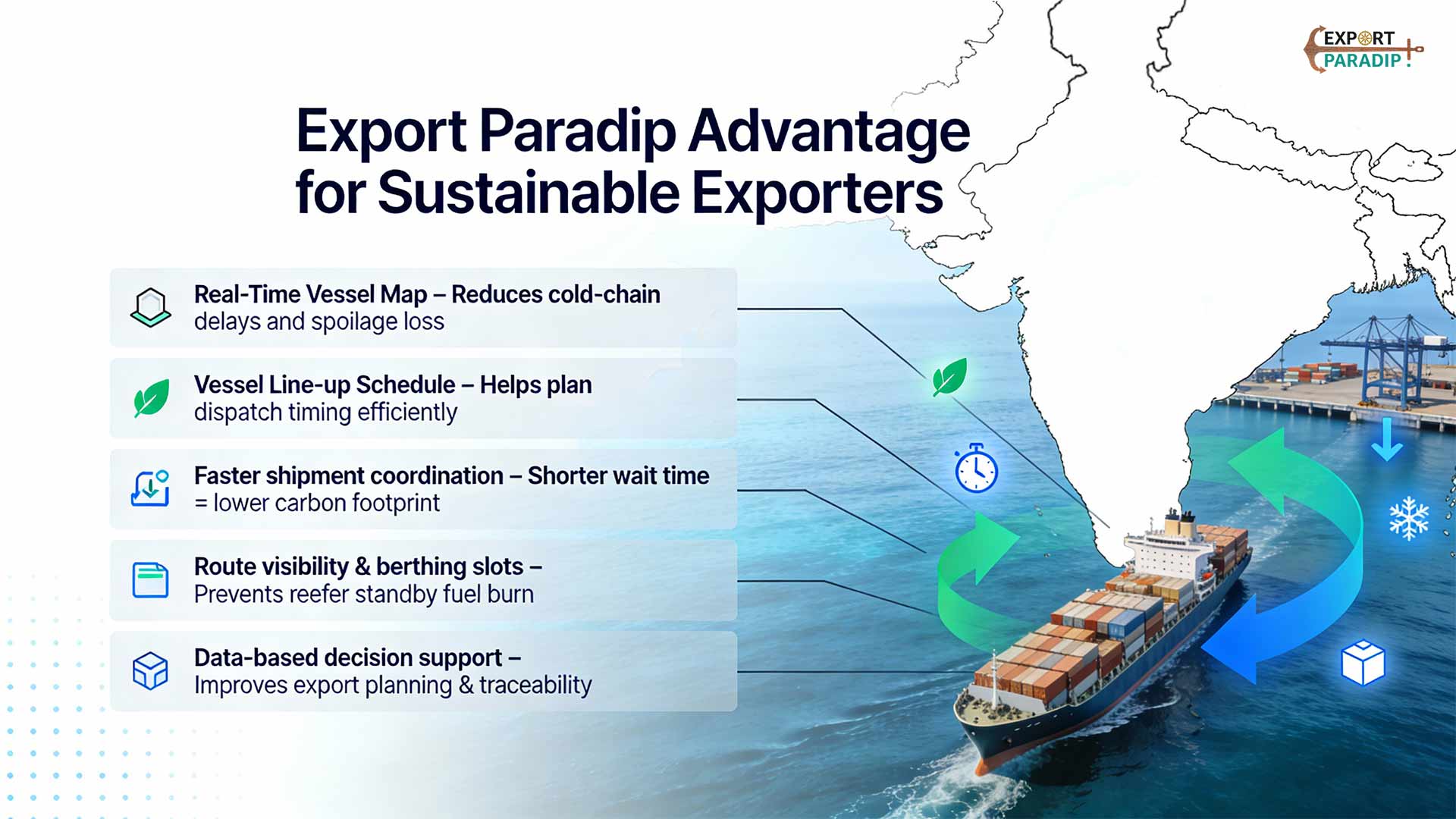
Sustainability thrives when exporters have access to real-time data, shipping options & port-based decision support. Export Paradip plays a pivotal role here by simplifying global cargo movement for exporters at the planning stage itself. With live vessel visibility & predictable scheduling, wastage, demurrage & energy leakage reduce dramatically, directly enhancing sustainability performance.
Export Paradip offers two essential operational tools that support sustainable export systems:
This tool enables exporters to track vessel movements, monitor anchorage status, estimate turnaround windows & schedule freight without uncertainty. For marine & agro shipments where freshness & temperature integrity are critical, real-time vessel visibility is invaluable.
Paradip Port Vessel Line-Up Schedule
Exporters can track upcoming vessels, ETAs, ETDs, berthing queues & rotation schedules ahead of time, allowing them to plan harvest cycles, factory processing, cold-chain dispatch & container booking more strategically. Smart planning means fewer storage delays & lower energy usage, a core sustainability gain. With these digital tools, exporters reduce logistic wastage, improve cold-chain efficiency, shorten stay times, minimise spoilage & deliver cargo faster into international markets. Export Paradip doesn’t just simplify shipping, it strengthens sustainability outcomes while increasing profitability.
Conclusion
The future of agro & marine exports belongs to those who combine quality with responsibility. Sustainable sourcing, ethical harvesting, residue-free growth, cold-chain discipline, renewable packaging & digital traceability are emerging as the most valued trade assets globally. Exporters who adapt early will not only secure better pricing, they will capture long-term shelf space in the world’s most lucrative food markets.
Export Paradip is committed to empowering exporters in this journey by offering live vessel tracking, scheduling intelligence, market access assistance & logistic planning support to help exporters scale confidently & globally. As sustainability continues to redefine international commerce, now is the best moment to rethink your export strategy & build responsibly for the future.
If you are an exporter aiming to enter global markets or improve your supply chain efficiency, we welcome your questions, queries, comments & collaborations. Connect with us, share this blog with your network, or explore ExportParadip.com to begin scaling sustainably & profitably.
Ready to Take Your Odisha Business Global?
Contact Export Paradip:
Email: exportparadip@gmail.com
Phone: 06744508186
FAQs (Frequently Asked Questions)
1. Why is sustainability critical for agro & marine exporters?
Because resource security, buyer expectations and international regulations now demand responsible production. Sustainable exporters face fewer rejections and enjoy higher valuation globally.
2.How does traceability help exporters gain more buyers?
Traceability assures buyers of product origin, storage quality and ethical sourcing, leading to faster contract approvals and greater trust.
3. What type of packaging is recommended for sustainable exports?
Biodegradable trays, kraft paper, jute/hemp sacks, recyclable LDPE and PLA-based bioplastics are widely accepted eco-friendly export packaging materials.
4.Can Export Paradip help in planning sustainable export shipments?
Yes. With the Paradip Vessel Map and Vessel Line-Up Schedule, exporters can plan shipments efficiently, reduce storage delays, minimise cold-chain wastage and improve sustainability performance.
5. Which international markets prefer sustainable agro & marine products?
The EU, Japan, the UK, the US, Canada and Gulf countries are currently leading demand for traceable, eco-friendly exports with strict import standards.